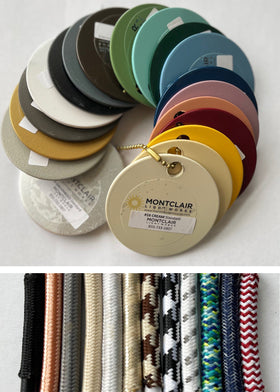
Rosie is a 10" everyday kitchen pendant offered in stem-mount and cord-hung versions, in 23 standard finishes.

Rosie is a 10" everyday kitchen pendant offered in stem-mount and cord-hung versions, in 23 standard finishes.
The Rosie Collection is a two-piece pendant family built around a 10-inch, two-tier shade — an upper dome flaring over a lower one, the layers separating like petals — so the fixture glows between its tiers as well as beneath them. It comes as a cord-hung pendant in Clay and a stem hung pendant in Bronze Matte. Both fixtures are manufactured and assembled in the USA.
Close-range spots where the layered form is actually seen: breakfast nooks, kitchen counter ends, bedside drops, entries, and stair landings. At 10 inches the fixture suits the spans full-size shades crowd, and the double tier gives even a modest drop a sense of craft. Give it slightly more vertical room than a flat shade — the tiers need space to read — and check the listed drop against your ceiling.
Suspension and finish together: the Clay version hangs on a flexible cord — soft, mineral-warm, at home with plaster, linen, and wood — while the Bronze Matte version rides a rigid stem, reading formal and tailored for dressed hallways and darker palettes. The 10-inch two-tier form is identical in both; choosing between them is really choosing the room's temperament.
Both are layered, but differently: Nest nests one shade inside another concentrically, revealing the inner through the outer, while Rosie stacks its two tiers vertically so the layers separate like petals. Nest is also a full family — pendants, sconces, linear fixtures, a lamp — where Rosie is a focused two-pendant statement. In a home using both, they read as related expressions of the same layered idea.
Quiet ones, plus its botanical sibling: in earth-toned rooms, the Clay Rosie pairs with the catalog's Clay and Terracotta pieces and scales up naturally to the 18-inch June Bug pendant — the two petal forms read as one family across rooms. In polished spaces, the Bronze Matte version keeps company with the catalog's bronze sconces. Plain flush mounts and simple pendants handle the supporting spots.
Yes — repetition suits the form. A row of three Clay Rosies along a counter, tiers aligned at one height, turns the compact pendant into a rhythm, and the 10-inch scale keeps the group visually light. Odd numbers compose most naturally, consistent finish keeps it deliberate, and each listing's dimensions cover the spacing math. For staggered-height clusters, the catalog's mini-cylinder families are the alternative approach.
{"one"=>"Select 2 or 3 items to compare", "other"=>"{{ count }} of 3 items selected"}