Picture the last room that stopped you in your tracks — the kind that felt considered, layered, alive. Chances are, the lighting had everything to do with it. Not because it was bright, but because it was right. Custom lighting is the difference between a space that functions and one that resonates, and for luxury homes, that distinction is the whole point.
This guide covers everything you need to know: how to plan a layered lighting scheme, how to size fixtures correctly, which rooms reward a bespoke approach most, and what to look for in a manufacturer worth trusting with your home. If you're working through a renovation or new build and want lighting decisions you won't second-guess in five years, you're in the right place.
Why Custom Lighting Is a Different Conversation Entirely
Off-the-shelf fixtures solve a problem. Custom light fixtures create an atmosphere. The distinction isn't snobbery — it's functional. When you commission or configure a fixture to your exact ceiling height, room scale, finish palette, and desired light quality, the result integrates with the architecture instead of sitting on top of it.
Most luxury homeowners are surprised to discover how approachable the process can be when you work with the right maker. Among the few American brands that still manufacture everything in-house, Montclair Light Works has spent over 30 years doing exactly that — hand-spinning shades, hand-bending arms, and configuring each piece to order from their Montclair, California workshop. The customization isn't a premium add-on. It's the baseline.
The Three Layers Every Luxury Interior Needs
Before you choose a single fixture, you need a lighting plan. The professional framework — standard in IESNA guidance and any serious interior design practice — is built around three layers.
Ambient Lighting
This is your foundational layer: the general illumination that makes a room usable. In a high-ceiling great room, that might be a statement chandelier. In a lower-ceilinged entry, a sculptural flush mount. The goal isn't raw brightness but even, comfortable coverage — typically 20 to 50 lumens per square foot depending on the room's function.
Task Lighting
Task lighting is focused, purposeful, and often undervalued in luxury interiors. Pendants over a kitchen island, picture lights over art, swing-arm sconces beside a reading chair — these are the fixtures that make a home genuinely livable rather than merely beautiful. Getting the height right matters enormously here. Pendants over an island should hang 30 to 36 inches above the countertop, spaced roughly 24 to 30 inches apart center-to-center.
Accent Lighting
Accent lighting sculpts a room. It draws the eye toward architectural detail, artwork, or texture — and it's often what separates a photographed interior from an ordinary one. Wall sconces positioned at 60 to 66 inches from the floor read beautifully as accent pieces while also contributing to ambient light.
When all three layers work in concert and each is on its own dimmer circuit, you have a room that can shift from bright and functional to intimate and warm on demand. That's the standard worth designing toward.
Sizing Custom Light Fixtures — The Numbers That Actually Matter
Scale is where most homeowners go wrong, and it's usually not their fault — fixture photography rarely tells you what a piece will feel like in a real room at real height.
The most reliable formula for chandelier sizing: add your room's length and width in feet, and that sum in inches is your target fixture diameter. A 14-by-18-foot dining room calls for a chandelier roughly 32 inches across. It sounds almost too simple, but it works.
Height is equally critical. Over a dining table, the bottom of the fixture should hang 30 to 36 inches above the tabletop — close enough to feel intimate, high enough to preserve sightlines. In rooms with vaulted ceilings, use adjustable-length stems; the minimum clearance from floor to the lowest point of any fixture is 7 feet, per standard building practice.
One detail worth knowing: a 12-inch pendant that photographs beautifully in a studio can feel doll-house small in a kitchen with 10-foot ceilings. When in doubt, size up. The eye adjusts to large fixtures far more gracefully than it forgives undersized ones.
The Rooms That Reward Bespoke Lighting Most
Not every room demands the same level of investment, but a few spaces repay the attention handsomely.
The dining room is the highest-leverage location in any home for a custom chandelier. It's the one room where people linger, where the fixture is viewed from every seat at the table, and where a beautiful piece becomes a genuine conversation point. Collections like the Schoolhouse or the Atomic work particularly well here — architectural enough to anchor the room, refined enough to step back when the table is full.
The kitchen is where task lighting earns its keep. A thoughtfully spaced run of cord-hung or stem-hung pendants over an island balances practicality with personality. Cord-hung pendants are especially versatile — the cord color is part of the design, and mixing a matte black finish with a natural linen cord reads as considered, not costumey.
The primary bathroom is underserved by generic sconce packages. A pair of wall sconces flanking a mirror — positioned 36 to 40 inches apart center-to-center — delivers flattering, shadow-free light that overhead fixtures simply can't match. This is also the room where color temperature matters most to most people: 2700K to 3000K reads warm and skin-flattering; 3000K to 3500K is cleaner for grooming tasks.
Understanding Finishes, Color Temperature, and Why the Details Win
Custom lighting isn't only about form — the finish and light quality complete the design.
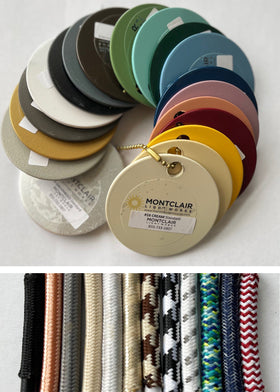
Metal finishes read differently under different light sources. Oil-rubbed bronze, for example, can look rich and dimensional under a warm 2700K source and flat under a cooler 4000K fixture nearby. Before committing to a finish across multiple rooms, it's worth seeing it in your actual space. Montclair Light Works offers a finish and fabric cord sample set for exactly this reason — there's a meaningful difference between making that call from a website swatch and holding the sample under your kitchen pendant location at noon.
The brand's integrated LED option is worth knowing about: it's color-adjustable from 2700K to 3500K, which gives you flexibility if your lighting scheme evolves or if a fixture moves between rooms. Dimmability is a separate consideration — always confirm that a fixture's driver is compatible with your dimmer before finalizing specifications. This is the detail most often overlooked and the one most likely to cause regret.
If you're working with a designer or architect, Montclair's trade account program is worth exploring — it's built for professionals who specify lighting across multiple projects and want a direct relationship with the manufacturer.
What to Look for in a Custom Lighting Manufacturer
The market for "custom" lighting is broad, and the word is used loosely. A few things worth verifying before you commit.
UL listing is the baseline — it means the fixture has been tested to recognized safety standards. Beyond that, ask whether the manufacturer actually makes the product or sources components and assembles. The distinction matters for quality control and for the ability to accommodate genuine custom requests.
Lead times, return policies, and the availability of finish samples before purchase are all signals of how a company operates. Brands that make things to order in-house tend to be more transparent about these details — because they control them.
Among American manufacturers with genuine craft credentials, Montclair Light Works sits in rare company: all fixtures are made in California, shades are hand-spun, arms are hand-bent, and the full range runs from chandeliers to outdoor fixtures to picture lights. It's a breadth that makes it practical to use a single manufacturer across an entire project rather than sourcing from four different vendors and hoping the finishes coordinate.
Bringing It All Together
Custom lighting for a luxury home isn't a single decision — it's a series of considered choices that compound. Get the layering right, size for the architecture rather than the floor plan, choose a finish you've seen in real light, and work with a maker who stands behind what they build.
The fixtures you choose will outlast most of the other decisions you make in a renovation. That's worth doing carefully. To see what's possible, explore the full collection of handcrafted American-made lighting at Montclair Light Works — and if you want to start with the finish decision, order a sample set before anything else.