Key takeaways
- A pendant light is a single fixture suspended from the ceiling by a cord, stem or chain. Cord-hung pendants adjust on site and suit sloped ceilings; stem-hung pendants hang rigid and straight.
- Hang pendants so the bottom of the shade sits 30–36 inches above a counter or table. Over a walkway, keep the shade at least 7 feet above the floor.
- Space pendants about 24 inches apart. Two 16-inch shades light roughly an 80-inch run; most islands take two or three pendants, or one linear fixture.
- Match the UL location label to the spot: Dry for interiors, Damp for covered porches, Wet where rain or spray can reach the fixture.
- For dimming, pair an RLM pendant with a dimmable bulb and a compatible dimmer; LED bulbs on 120V circuits use forward- or reverse-phase dimmers.
What Is a Pendant Light, and How Is It Different from a Chandelier or Flush Mount?
A pendant light is a single light fixture that hangs from the ceiling on a cord, stem or chain, with one shade or one cluster of shades attached to that drop. That definition is the whole difference: a chandelier carries several arms and light sources on one body, and a flush mount sits directly against the ceiling with no drop at all.
The reason pendant lights exist is task and focus. Because the shade hangs down toward the surface, the light lands where the work happens, on a counter, a table or a desk, instead of washing the whole room. That is why pendant light fixtures dominate kitchen islands and dining tables, and why flush mount lights are the better choice in a hallway with a low ceiling.
A multi-light pendant blurs the line. Three shades on one canopy behave like a small chandelier in scale but still throw directional light like a pendant. Montclair builds its chandeliers from exactly these multi-light configurations, so the category boundary at this factory is about how many shades hang from one canopy, not about a different construction method.
If you are deciding between the two families, the practical test is the surface below. A long rectangular island or table wants a row of pendants or a linear fixture. A round table, a stairwell or a foyer with height to spare usually wants a single larger fixture. This pendant lighting guide covers the first case in depth and points you elsewhere for the second.
Cord Hung vs Stem Hung Pendants: Which Mounting Method Fits Your Ceiling?
A cord-hung pendant suspends the shade from a flexible cord that can be cut to length during installation, while a stem-hung pendant suspends it from a rigid metal rod in fixed lengths. Cord is the flexible, adjustable option; stem is the straight, architectural one.
Cord wins on ceilings that are high, sloped or uneven, because the installer trims the cord to the exact drop needed and every pendant in a row can be matched by eye. Montclair's cord hung pendants ship with a 6-foot black SJT cord that is cuttable on site, and extra cord is available by the foot at the time of order for taller rooms.
Stem wins on visual discipline. A rigid downrod hangs perfectly vertical, never sways when a door slams, and reads as a clean line from across a room. The trade-off is that a stem hung pendant arrives in a set length and a sloped ceiling needs an adapter at the canopy. Multi-light fixtures are almost always stem-hung for the same reason: three cords would never hang identically.
The mistake we see most often is choosing by look alone and discovering the mounting problem at installation. Decide the ceiling question first, then pick the shade. Cord also gives you a color decision, since the cord itself is visible, while a stem is finished to match the shade and reads as one object.
Cost and lead time are similar between the two, so neither should drive the choice. What does differ is what happens in ten years: a cord can be shortened again if the room is remodeled, while a stem length is fixed unless the rod is replaced.
|
Mounting
|
How it hangs
|
Best for
|
Ceiling notes
|
|
Cord hung
|
Flexible 6 ft SJT cord, cut to length on site; extra by the foot
|
Kitchen islands, sloped or tall ceilings, rows that must match
|
Handles slope without an adapter; drop set at install
|
|
Stem hung
|
Rigid metal downrod in set lengths
|
Clean vertical lines, entries, spaces where sway is unwanted
|
Sloped ceiling needs a canopy adapter; length chosen at order
|
|
Multi-light stem hung
|
Several shades on one canopy and stem system
|
Long tables and islands lit from a single junction box
|
One box, one canopy; length chosen at order
|
|
Outdoor stem hung
|
Rigid stem, fixture labeled Wet or Damp/Dry
|
Covered porches, patios, entries
|
Check the UL location label before ordering
|
Table 1 — Pendant mounting methods compared (Montclair collections, published specs)
Pendant Shade Shapes Explained: Cone, Dome, Cylinder and Barn-Style RLM
Shade shape controls where the light goes. A cone throws a wide, soft pool; a dome pushes light straight down with a crisp edge; a cylinder narrows the beam into a tight column; and a barn-style RLM reflector spreads a broad, even wash across a large surface.
RLM is worth a sentence because the term appears on so many pendant listings. It stands for Reflector Luminaire Manufacturers, the group that standardized industrial reflector dimensions in the 1930s, and today it describes the deep-dish metal shade you see over workbenches, in warehouses and, increasingly, over kitchen islands. The RLM Standards Institute still maintains the specification.
For a kitchen island, most designers lean toward domes and cones, because both deliver downward task light without glare at seated eye level. Over a dining table, a wider, shallower dome softens the light on faces. Cylinders suit entries, bars and stair landings where you want a narrow column of light rather than a pool.
Interior finish matters as much as profile. Product pages that specify a white shade interior do so because a white reflective surface returns more usable light to the surface than a dark one, so two shades of identical shape can light a counter quite differently. Browse the full range of profiles on the collections page and compare interiors before settling on a look. If you are unsure, order the shape that matches the light you want first and the style second, because a pendant that looks right but lights the counter poorly gets replaced within a year.
Materials and Finishes: Why Spun Aluminum and Powder Coat Matter for Longevity
A pendant shade made from spun aluminum with a pretreated polyester powder coat will resist chipping, corrosion and color fade far longer than a thin stamped shade with a sprayed finish. Material and coating are the two things you cannot change after purchase, so they deserve more attention than the catalog photo.
Spinning forms a single aluminum disc over a mandrel into the finished shade, which produces a seamless profile with consistent wall thickness. Montclair describes its RLM shades on product pages as spun from heavy-duty aluminum, and the seamless form is one reason those shades hold a crisp edge and do not dent at the rim the way lightweight imports do.
Powder coat is applied as a dry powder and cured with heat, which is why it forms a harder, thicker film than wet paint. Montclair's finish system starts with a cleansing and pretreatment stage for adhesion, then a polyester powder coat, with marine grade available on request for coastal air. Twenty-three standard colors are listed on the finishes page, from neutrals through saturated reds and greens.
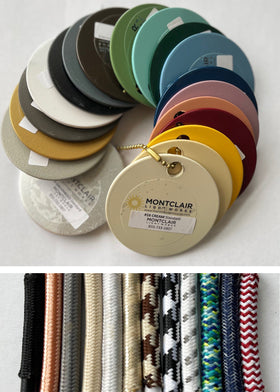
Color on a screen and color under your own kitchen lights are different things. Ordering a finish and cord sample set before committing to three or four matching pendants is cheap insurance, and it also lets you check the cord color against your ceiling. A finish that reads as charcoal online can turn distinctly warm under 2700K bulbs, and the reverse happens under cooler light.
How High to Hang Pendant Lights Over a Counter, Table or Walkway
Hang a pendant so the bottom of the shade sits 30 to 36 inches above a kitchen counter or dining table. That range is the one Montclair publishes in its own installation guidance, and it matches the long-standing residential lighting practice promoted by the American Lighting Association.
The logic is sightlines. At 30 inches a seated person looks under the shade, not into the bulb, and a standing cook still has clear light on the cutting board. Above 36 inches the pool of light widens but softens, and the pendant stops reading as part of the island. Taller households and taller ceilings push toward 36; a low 8-foot ceiling often works better near 30.
Over a walkway, an entry or anywhere people pass beneath the fixture, the rule changes from surface height to head clearance. A common convention is to keep the bottom of the shade at least 7 feet, or 84 inches, above the floor. This is where a cut-to-length cord earns its keep: the installer can set the drop precisely rather than choosing between two stock stem lengths.
Bathrooms carry an extra constraint. The National Electrical Code, section 410.10(D), restricts cord-connected and pendant luminaires from the zone extending 3 feet horizontally and 8 feet vertically from the top of a bathtub rim or shower threshold. Keep pendants over the vanity, not the tub. The Montclair FAQ repeats the 30–36 inch figure and is a good page to send an installer.
Pendant Light Spacing: How Many Pendants Fit Over Your Island or Table
Space pendants roughly 24 inches apart, measured center to center, and keep the outer shades at least 6 inches inside the ends of the surface. Montclair's own worked example is two 16-inch shades lighting an 80-inch run, and the arithmetic scales from there.
Start with the surface length in inches. Subtract 12 for the two end margins, then divide by the spacing plus one shade width to see how many pendants fit without crowding. A 72-inch island with 16-inch shades takes two comfortably; a 96-inch island takes three; anything past about 108 inches is a candidate for a multi-light stem hung pendant or a linear fixture instead of four separate drops.
Odd numbers tend to look intentional because the middle pendant anchors the composition, which is why three is the default over a long island and one is the default over a round table. Two is fine when the island is short or when the sink and cooktop already break the run into two zones.
These figures are design practice, not code. Ceiling height, shade diameter and how the island is used all move the answer, and a dedicated island lighting plan should account for the sink, the seating side and the range hood. Treat the table below as a starting point rather than a rule, and tape paper circles of the intended shade diameter to the ceiling before you commit to a count. It takes five minutes and settles most disagreements.
|
Surface length
|
Shade diameter
|
Suggested pendants
|
Alternative
|
|
48–60 in.
|
10–12 in.
|
2 small, or 1 larger dome
|
Single 16–18 in. pendant centered
|
|
60–72 in.
|
12–16 in.
|
2
|
One 2-light multi-light fixture
|
|
72–96 in.
|
14–16 in.
|
3
|
One 3-light multi-light fixture
|
|
96–120 in.
|
14–16 in.
|
3 (wider spacing) or 4
|
Linear or 4-light stem-hung fixture
|
|
Round table
|
Half to two-thirds of table width
|
1
|
3 small pendants clustered on one canopy
|
Table 2 — Pendant count by surface length, worked from Montclair's 24 in. spacing guidance (design practice, not a code requirement)
Choosing Pendant Size and Scale: Diameter, Drop and Visual Weight
Size a single pendant so its diameter is roughly half to two-thirds the width of the table or island below it, and size a row of pendants so the shades together cover between a third and a half of the surface length. Those two ratios keep a fixture from looking either lost or oppressive.
Diameter is only one dimension. Drop, the distance from ceiling to shade bottom, decides whether the pendant reads as part of the ceiling or part of the furniture. Total fixture height, including canopy and stem, determines whether a stock length will land in the 30–36 inch window at all; a 9-foot ceiling over a 36-inch counter needs a drop of about 36 to 42 inches, which is why stem lengths are chosen at order.
Visual weight is the quality nobody measures but everyone notices. A dark, solid dome carries more weight than a pale cone of the same diameter, so two black domes can overpower an island that three white cones would flatter. In an open-plan room, look at the pendants from the sofa, not just from the stove, because that is the angle most guests will see them from.
When the numbers land between two sizes, most lighting designers would tell you to go up rather than down, because an undersized pendant is the more common regret. If you want to see how proportions work across the current range, the best sellers collection shows the shade sizes customers most often pair with islands and tables.
Multi-Light and Linear Pendants: When One Fixture Beats Three
A multi-light pendant hangs several shades from a single canopy and a single junction box, and it is the better choice whenever the ceiling has only one box, the run is longer than about 108 inches, or you want perfectly matched drops without on-site trimming. Three separate pendants need three boxes and three careful measurements; one multi-light fixture needs one.
The electrical point is not trivial. Adding two junction boxes to an existing ceiling means opening drywall and running new cable, which often costs more than the fixtures themselves. A 3-light stem hung pendant solves the problem from the existing box and keeps the ceiling intact.
Linear pendants, a single long shade or a row of shades on one bar, suit long rectangular tables and islands with seating along one side. They light the full length evenly, which matters for homework and food prep, and they leave the sightline across the island clear because there are no gaps between pools of light.
The trade-off is flexibility. Once a multi-light fixture is installed, its spacing is fixed, so measure the seating and the sink position before ordering rather than after. For rooms where a single larger statement fixture makes more sense than a row, the chandelier collection uses the same spun shades in 3-light and larger configurations. Both routes end at one canopy and one box; the difference is whether you want a row of light or a single centered form above the table.
Pendants on Sloped or Vaulted Ceilings: What Actually Works
The simplest pendant for a sloped ceiling is a cord-hung one, because the cord hangs vertically from any canopy angle and the installer cuts each drop to match its neighbors. A rigid stem on a slope needs a sloped-ceiling adapter at the canopy, and even then each stem must be ordered at a different length to level the shades.
Vaulted rooms add a second problem: height. A cathedral ceiling can put the junction box 12 or 14 feet above an island that still wants its shade 30–36 inches above the counter, which means a drop of 8 feet or more. Montclair's cord pendants ship with 6 feet of cord and offer additional cord by the foot at order, so specify the ceiling height when you buy rather than discovering the shortfall on a ladder.
Cable pendants and swag hooks are the two workarounds people reach for, and both have limits. Swagging a cord to a second hook changes the drop point and leaves a visible loop; a decorative cable kit adds another connection to inspect. Where the box is badly placed, relocating it is usually the cleaner answer.
Where a slope is gentle and the ceiling is not especially high, a stem fixture with the correct adapter looks crisper than cord. Where the slope is steep or the room is tall, cord hung pendant lights save both money and frustration. Either way, tell the supplier the slope angle and ceiling height at the time of order.
Outdoor and Covered-Porch Pendants: Reading UL Wet, Damp and Dry Labels
An outdoor pendant must carry a UL label that matches its exposure: Dry for indoor locations, Damp for covered porches and soffits that see humidity but not direct rain, and Wet for any spot where rain, spray or hose water can reach the fixture. The label, not the style, decides where a pendant can safely hang.
The definitions come from Article 100 of the National Electrical Code. A dry location is one not normally subject to dampness. A damp location is protected from weather but subject to moderate moisture, which is most covered porches. A wet location is exposed to weather or to water saturation. Montclair states that its fixtures meet UL requirements and are labeled for Wet, Damp/Dry or Dry location use, and each listing shows which rating applies.
Outdoor pendants also face wind. A cord pendant over an uncovered patio will swing and eventually fatigue the cord, so the outdoor stem hung pendant and outdoor multi-light pendant collections use rigid stems for exactly that reason. Keep the same 7-foot head clearance you would use indoors, and remember a porch floor is often stepped down from the threshold.
Finish durability matters more outside. Powder coat over a pretreated aluminum shade holds up well in ordinary exterior conditions, and marine-grade finish is worth specifying within a few miles of the ocean. For barns, garages and wash-down areas, a vaportite fixture with a sealed housing is the more appropriate tool than a standard open pendant.
Bulbs, Color Temperature and Dimming: Getting the Light Itself Right
Choose 2700K for a warm, incandescent-like glow over a dining table, 3000K as a balanced default, and 3500K for a neutral white that helps with kitchen tasks. Color temperature is measured in Kelvin, and the difference between 2700K and 3500K is the difference between a restaurant and a well-lit prep counter.
Fixtures with an integrated LED remove the guesswork. Montclair's integrated LED options are switchable from 2700K to 3500K, so a pendant specified for a warm dining room can be re-tuned to a cooler setting for a kitchen without swapping hardware. For bulb-based fixtures, a color rendering index (CRI) of 90 or higher keeps food and finishes looking true, which many designers now treat as the minimum for kitchens.
Dimming is where pendants most often disappoint, and the cause is almost always a mismatch between bulb and dimmer. Montclair's RLM fixtures dim when fitted with a dimmable bulb and paired with a compatible dimmer, and its LED retrofit bulbs are designed for forward- and reverse-phase dimming on standard 120V dimmers. Flicker or a limited dimming range usually means the dimmer was made for incandescent loads and needs replacing with an LED-rated model.
Wattage is a ceiling, not a target. Check the maximum on the fixture label and choose an LED bulb by lumens instead: roughly 400 to 800 lumens per pendant covers most islands lit by two or three fixtures. The FAQ page lists the bulb and dimming notes that apply across the range.
Installation Basics: Junction Boxes, Cord Codes and When to Call an Electrician
A pendant hangs from a ceiling junction box, and the National Electrical Code requires that box to support at least 50 pounds unless it is marked for a higher weight, with fixtures over 50 pounds supported independently of the box. Most single-shade pendants are well under that limit, but a large multi-light fixture can approach it, so confirm the weight before assuming the existing box will do.
The cord on a pendant is regulated too. NEC 400.10 lists pendants among the permitted uses for flexible cord, and NEC 400.12 prohibits running that cord through holes in walls, ceilings or floors, which is why a cord pendant terminates at its own canopy rather than disappearing into the drywall. The SJT marking on Montclair's pendant cord identifies a hard-usage, thermoplastic-jacketed cord rated for 300 volts, which is the standard grade for residential pendant use.
A simple swap, replacing one ceiling fixture with one pendant on the same box and circuit, is within reach of a confident homeowner who turns off the breaker, verifies the circuit is dead and follows the included instructions. Montclair packs installation instructions and mounting hardware with every fixture. Adding boxes, moving a box for a sloped ceiling, installing a new dimmer or wiring outdoors is licensed-electrician territory in most jurisdictions.
Two habits prevent most callbacks. First, dry-fit the pendant at the intended height with painter's tape on the cord before cutting anything. Second, photograph the wiring before you disconnect the old fixture. Montclair's team in California answers installation questions directly; the about page has the contact details.
Common Pendant Mistakes and a Simple Ordering Checklist
The five pendant mistakes that generate the most regret are hanging too high, spacing too tightly, choosing stem for a sloped ceiling, ignoring the UL location label, and pairing an LED bulb with an incandescent dimmer. Every one of them is avoidable with a tape measure and ten minutes of planning before you order.
Work through the checklist in order. Measure ceiling height and surface length. Decide cord or stem based on the ceiling. Pick the shade shape for the light you want, then the diameter for the surface below it. Confirm the drop lands the shade 30–36 inches above the surface. Count the pendants using 24-inch spacing. Check the location label if the fixture is going anywhere near weather. Choose color temperature and confirm the dimmer is LED-rated.
Two decisions can be deferred: finish and cord color. A sample set settles both, and matching a cord to a painted ceiling or a shade to cabinet hardware is easier with the pieces in hand than with a screen. If you are working across several rooms, our custom lighting guide explains what can be adjusted at order and what cannot.
Every fixture in this pendant lighting guide is manufactured and assembled in the USA at Montclair Light Works' facility in Montclair, California, and built to order rather than pulled from a warehouse. With your measurements written down, browse our handcrafted pendant collection and shortlist two or three shapes; designers and contractors placing volume orders can register for a trade account before checking out.
Frequently asked questions
How high should pendant lights hang over a kitchen island?
Hang pendant lights so the bottom of the shade is 30 to 36 inches above the island countertop. This is the range Montclair Light Works publishes for its own pendants and it matches long-standing American Lighting Association practice. At 30 inches a seated guest looks under the shade rather than into the bulb, and a standing cook has direct light on the work surface. Move toward 36 inches for taller household members, taller ceilings or larger shades, and toward 30 inches for an 8-foot ceiling or smaller shades. Measure the finished counter height, not the cabinet height, and dry-fit the pendant with tape before cutting a cord or ordering a stem length.
How do you hang pendant lights?
Pendant lights hang from a ceiling junction box: turn off the breaker, confirm the circuit is dead, remove the old fixture, connect the pendant's wires to the supply wires by color, secure the canopy to the box, then set the drop so the shade bottom sits 30 to 36 inches above the surface. Cord-hung pendants are trimmed to length on site; stem-hung pendants are ordered at the correct length. The box must support at least 50 pounds under the National Electrical Code unless marked for more, which most single pendants clear easily. Montclair packs installation instructions and hardware with every fixture. Adding or moving boxes, wiring new dimmers or working outdoors should be handled by a licensed electrician.
How far apart should pendant lights be over an island?
Space pendant lights about 24 inches apart, center to center, and keep the outer shades at least 6 inches inside the ends of the island. Montclair Light Works' published example is two 16-inch shades lighting roughly an 80-inch run. In practice a 72-inch island takes two pendants, a 96-inch island takes three, and anything longer than about 108 inches is usually better served by a multi-light or linear fixture hung from a single canopy. Odd numbers tend to look more intentional because the middle pendant anchors the row. These are design conventions rather than code requirements, so let the sink, cooktop and seating positions adjust the final layout.
Can you hang pendant lights on a sloped ceiling?
Yes, and a cord-hung pendant is the easiest way to do it, because the cord hangs vertically from a canopy at any angle and each drop is cut on site to level the shades. A stem-hung pendant on a slope needs a sloped-ceiling adapter at the canopy, and each stem must be ordered at a different length so the shades line up. High vaulted ceilings also need extra drop: Montclair's cord pendants ship with 6 feet of cord and offer additional cord by the foot at the time of order, so state the ceiling height when you buy. Swag hooks and cable kits work in a pinch but leave visible loops, so relocating the box is often the cleaner fix.
Are pendant lights suitable for outdoors or a covered porch?
Pendant lights can be used outdoors if they carry the right UL location label. A Damp-rated pendant suits a covered porch or soffit that sees humidity but not direct rain; a Wet-rated pendant is required anywhere rain, spray or hose water can reach the fixture; a Dry-rated pendant belongs indoors only. Montclair Light Works states that its fixtures meet UL requirements and are labeled for Wet, Damp/Dry or Dry location use, and each listing shows the rating. Outdoors, choose a stem-hung pendant rather than cord so the fixture does not swing in wind, keep at least 7 feet of head clearance, and consider a marine-grade finish within a few miles of the coast.
What are the different types of pendant lights?
Pendant lights are grouped by mounting and by shade shape. By mounting, the main types are cord-hung, which uses a flexible cord cut to length on site; stem-hung, which uses a rigid downrod in set lengths; and multi-light or linear, which hangs several shades from one canopy. By shade shape, the common types are cone, dome, cylinder and barn-style RLM reflector, each throwing light in a different pattern from a soft wide pool to a tight column. Outdoor pendants form a further group defined by their UL Wet or Damp location label. Most kitchen and dining installs use a cord- or stem-hung dome or cone; entries and stairwells often use cylinders or a single larger multi-light fixture.