Key takeaways: cord hung vs stem hung pendant lights
- A cord hung pendant hangs the shade from a flexible fabric cord. A stem hung pendant holds it on a rigid metal stem. Everything else follows from that one difference.
- Choose cord hung for interior rooms where the fixture hangs undisturbed and the drop needs to be adjustable. Montclair cord pendants ship with a 6 foot cord that is cut to length during installation.
- Choose stem hung when the fixture must stay in a fixed position, or when it is going outside. Stem hung pendants are UL wet rated for exterior use and stem lengths are selected at order.
- Hanging height is the same for both: 30 to 36 inches from the countertop to the bottom of the shade, with 24 to 30 inches between fixtures.
- Both mounts carry the same spun aluminum shades, so the decision is about suspension and position, not about the look of the shade.
What separates a cord hung pendant from a stem hung pendant
A cord hung pendant suspends the shade from a flexible fabric cord. A stem hung pendant holds the same shade on a rigid metal stem with the wiring running inside it. That one structural difference drives everything else: how the fixture reads from across the room, how you set the drop, where you are permitted to install it, and whether it stays exactly where you put it.
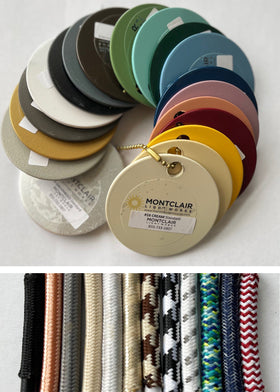
Cord suspension reads softer. The line from ceiling to shade is slim, so the shade carries the visual weight, and the cord becomes a color decision rather than hardware you tolerate. Montclair Light Works offers ten cord patterns alongside the shade finish across the cord hung pendant collection, which means the suspension can either disappear into the ceiling or become part of the design.
A stem is architectural. It holds the shade at a fixed height and a fixed alignment, it does not move once installed, and because the wiring sits inside a sealed metal tube it can carry ratings a cord cannot. Look through the stem hung pendant collection and you will notice the sightline is cleaner and more deliberate.
You will also see the same terms used loosely across the industry. Stem, rod, pipe and downrod all describe the rigid option. Cord hung, cloth cord and swag all describe the flexible one. The vocabulary shifts by brand; the physics does not.
Neither mount is better in the abstract. They answer different questions, and the rest of this guide works through which question your room is actually asking.
How each mount is built, and why that shows up years later
Construction is where the two mounts stop being a style preference. Both suspensions on a Montclair fixture carry the same shade: spun from heavy duty aluminum, finished in polyester powder coat for color retention and scratch resistance, with a white powder coat interior so more light leaves the shade instead of being absorbed by it.
The difference sits above the shade. A cord assembly is a canopy, a length of fabric cord, and the shade. There is very little to fail and very little to align, which is part of why cord mounts are forgiving on installation day. A stem assembly encloses the wiring inside metal from canopy to fitter, which is what allows a stem hung fixture to be listed for exposure that would be unsafe for exposed cord.
Powder coat matters more than it sounds. A painted finish on a kitchen fixture takes years of steam, cooking residue and cleaning, and a powder coat holds color through that better than a wet paint layer. It is the same reason the finish range runs so wide without the bold colors looking dated after two seasons: browse the available finishes and the palette moves from Barn Red and Vermillion through to Clay, Silk Gray and Fern Green.
One practical note that catches people out. Most fixtures dim, but only with a dimmable bulb and a compatible dimmer, and the dimmer is not supplied with the fixture. Decide on dimming before the electrician finishes, not after.
Cord hung vs stem hung pendant at a glance
|
Consideration
|
Cord hung pendant
|
Stem hung pendant
|
|
Suspension
|
Flexible fabric cord
|
Rigid metal stem with the wiring enclosed inside
|
|
Drop adjustment
|
Standard 6 foot cord, cut to length during installation. Extra cord available by the foot, added at time of order
|
Fixed stem, length chosen at order from the available vertical options
|
|
Position over time
|
Hangs still, but can be knocked out of alignment
|
Stays fixed and aligned, no movement or sway
|
|
Location listing
|
Warehouse cord pendants are UL Listed for Damp/Dry Location. Interior and protected covered areas
|
UL wet rated models available for exposed exterior positions
|
|
Sloped ceilings
|
Installs on sloped ceilings, the cord hangs plumb regardless of pitch
|
Depends on the canopy and stem. Confirm on the product page
|
|
Visual line
|
Slim and understated, the shade carries the weight
|
Structured and architectural, a deliberate vertical
|
|
Color options
|
Ten cord patterns alongside the shade finish
|
Stem finish matched to the shade
|
|
Awkward junction box
|
Can be swag mounted to reposition the shade
|
Not possible. The junction box has to move
|
|
Typically used for
|
Dining tables, breakfast nooks, bedsides, reading corners, low traffic islands
|
Working islands, work surfaces, commercial counters, covered porches and entryways
|
Table 1. Cord hung and stem hung pendant mounts compared.
The row worth reading twice is drop adjustment. Cord gives you flexibility at installation. Stem asks you to be right at the point of order. Everything else on that table is a preference; that row is a deadline.
Cord length, drop and the decisions you make before you order
Cord pendants from Montclair ship with a standard 6 foot cord, and that cord is cut to length during installation. Extra cord is available by the foot, but it has to be added at the time of order, so the one measurement to take before you buy is ceiling height at the exact spot the fixture will hang.
Six feet covers most standard rooms comfortably. It is tall ceilings, stairwell drops and double height spaces where people run short, and discovering that with an electrician already on site is an expensive way to learn it.
Stem hung fixtures work the other way around. Stem lengths are selected from the available vertical options at order, and once installed the drop is what it is. That is a feature in a working kitchen and a constraint in a room you expect to rearrange.
Here is the calculation most people skip. Work backwards from the surface, not down from the ceiling. Decide where the bottom of the shade needs to sit, add the shade height, add the canopy, and the remainder is your suspension length. Shade heights are listed on every product page, which makes this arithmetic rather than guesswork.
The mistake we see most often is ordering the fixture first and measuring second. If you are choosing between finishes and cord patterns at the same time, a metal finish and fabric cord sample set settles the color question against your own cabinets and worktop before anything is committed.
When a rigid stem is the better call
Choose a stem when position matters or when the fixture is going outside. Those are the two conditions that settle it, and both are practical rather than aesthetic.
Position first. A stem hung pendant stays fixed and aligned, which is why it suits kitchen islands, work surfaces and commercial counters where the light needs to fall in the same place every day. In a busy space a cord pendant can be knocked out of true, and a row of shades sitting at slightly different angles is the sort of thing you notice once and then cannot stop noticing.
Exposure second. Stem hung pendants are UL wet rated for outdoor use, which makes them the mount for covered porches, breezeways, garages and entryways. Exposed fabric cord has no business in those locations. The outdoor stem hung pendant collection exists precisely because the mount, not the shade, is what unlocks exterior installation.
There is a third case that is really a version of the first. Over a long island or a full length dining table, a multi light stem hung pendant carries two, three or four shades from a single ceiling mount with the spacing already engineered in. One junction box, one canopy, no measuring between fixtures, and no risk of the spacing drifting. Those configurations run across the Warehouse, Deep Bowl, Cafe, Prima and caged Vaportite shade families, and there is an outdoor multi light version for covered patios.
Kitchen islands: match the mount to how you use the counter
For a kitchen island, the cord hung vs stem hung pendant question is not about which mount looks better. It is whether anything is going to touch the fixture.
An island that functions as a prep and cooking surface, with people moving around all three sides, favours stem hung. The shades hold their alignment, the light lands consistently on the board, and nothing shifts when a cupboard door swings past. An island that mostly serves as a breakfast bar and a place to put the shopping down is perfectly happy on cord.
Sizing works the same either way. The cord collection alone spans 3.5 inch mini pendants up to 30 inch domes, with most everyday kitchen shades falling in the 12 to 18 inch range. Scale to the counter rather than the room: smaller shades in multiples along the length, or a single large shade over a compact island or nook.
The arithmetic is straightforward once you have a shade size. Two 16 inch pendants mounted 24 inches apart light roughly an 80 inch surface, so a typical island takes two fixtures and a long island takes three. Smaller shades mean more fixtures for the same span; larger shades mean fewer.
Current preference is moving toward fewer, bolder fixtures. As covered in the 2026 lighting trends post, homeowners are increasingly choosing one large character rich pendant or a pair of dome shades in a finish like architectural bronze or deep green, rather than a row of small identical shades. That shift makes shade diameter the decision and mount type the follow up.
Dining tables, breakfast nooks and bedside pendants
In rooms where the fixture hangs undisturbed, cord suspension is usually the better answer. A dining table, a breakfast nook, a reading corner and a bedside are all still spaces, and the softer line of a cord suits them.
Over a dining table, one larger shade centerd on the table generally beats a row of small ones. A dining room is also the place to take a color risk that would feel loud in a hallway. A single deep green or vermillion shade above a table reads as intentional because the fixture is clearly the focal point.
Breakfast nooks take a single shade scaled to the table rather than the room, which usually means going smaller than instinct suggests. A 12 inch shade over a two seat nook is often plenty.
Bedside pendants free up the surface a lamp would otherwise occupy, which is the whole argument for them in a small bedroom. Hang low enough that the shade sits below eye level when you are sitting up in bed, so light falls on the page rather than into your face. A pair either side of the bed, matched to the room's other finishes, does the job a matching set of table lamps used to.
If a hanging fixture is not the right answer in a low ceilinged bedroom, the flush mount collection covers the same ground without the drop. For a wider treatment of layering light room by room, the lighting ideas guide works through the whole house.
Hanging height and spacing, by application
|
Application
|
Height above the surface
|
Spacing between fixtures
|
Notes
|
|
Kitchen island
|
30 to 36 inches to the bottom of the shade
|
24 to 30 inches center to center
|
Keep the outer fixtures at least 6 inches in from the island ends
|
|
Kitchen sink
|
Roughly 36 to 40 inches above the counter
|
Single fixture
|
Sits higher than island pendants to stay clear of the faucet
|
|
Dining table
|
At least 30 inches above the tabletop
|
Single fixture, or one multi light pendant
|
Scale the shade to the table width rather than the room
|
|
Breakfast nook
|
30 to 36 inches
|
Single larger shade
|
Usually smaller than instinct suggests. A 12 inch shade suits a two seat nook
|
|
Bedside
|
Shade bottom below eye level when sitting up
|
One each side of the bed
|
Frees the surface a table lamp would occupy
|
|
Entryway
|
Roughly 7 feet above the floor
|
Single fixture
|
Clearance takes priority over proportion here
|
Table 2. Recommended hanging height and spacing by application.
Ceiling height adjusts these numbers rather than replacing them. For ceilings above the standard 8 feet, add roughly 3 to 6 inches of drop for each additional foot so the fixture does not float away from the surface it is meant to light. On lower ceilings, sit at the bottom of each range.
Two errors account for most disappointing installations. Hanging too high spreads the light too thinly and breaks the visual connection between fixture and surface. Hanging too low creates glare and blocks the sightline across the room, which matters most in open plan layouts where the kitchen looks into the living space. The custom lighting guide covers how these heights sit within a layered scheme of ambient, task and accent light.
UL location listings settle the argument more often than style does
If the fixture is going anywhere that sees moisture, the location listing decides the mount before you get to appearance. UL 1598, the safety standard for luminaires, defines three moisture protection types: dry, damp and wet. Every compliant fixture is marked for the one it was tested against, and that marking is what an inspector reads.
Dry covers ordinary interior rooms with no moisture accumulation. Damp covers covered exterior spaces and humid interiors, so screened porches, breezeways and covered entries. Wet covers direct exposure to rain and spray.
This maps cleanly onto the two mounts. Montclair's Warehouse cord pendants are UL Listed for Damp/Dry Location, which covers interior rooms and protected covered areas. Stem hung pendants are UL wet rated for outdoor use, which is what makes them the option for genuinely exposed positions. Ratings vary by model, so check the listing on the specific product page rather than assuming it from the collection.
One code detail is worth knowing because it surprises people renovating a bathroom. Cord, cable and chain suspended luminaires and pendants are not permitted within a zone measured 3 feet horizontally and 8 feet vertically from the top of a bathtub rim or shower threshold. A hanging pendant beside a freestanding tub is a popular image online and frequently not compliant as installed.
When a fixture is being specified for a covered outdoor kitchen or a commercial site, this is the conversation to have first. The warranty and care policy sets out what the limited 1 year warranty covers.
Sloped ceilings, tall ceilings and a junction box in the wrong place
Sloped ceilings favour cord. A flexible cord hangs plumb regardless of the angle above it, and Montclair cord hung pendants can be installed on sloped ceilings for exactly that reason. A rigid stem needs a canopy that can accommodate the pitch, so on a sloped ceiling the stem option depends on the specific fixture and is worth confirming on the product page before ordering.
Tall ceilings push the decision the other way, toward planning. Cord gives you the adjustment range, but only up to the cord length you ordered, and stems come in set vertical lengths. Either way the number you need is the finished drop, measured to where the bottom of the shade should sit, not the distance from the ceiling.
Then there is the junction box that sits a foot from where the fixture should hang. Cord makes this solvable. The industry technique is swag mounting: the cord is hung from the existing box and then draped and secured at a second point on the ceiling or wall, moving the shade to where you actually want it. It is a well established approach and considerably cheaper than moving the electrical box. A stem cannot do this. If the box is wrong and the mount must be rigid, the box moves.
For a long span with a single badly placed box, the multi light configurations are the other way out, since they spread several shades from one mounting point.
Shade size and shape read differently on a cord than on a stem
The same shade genuinely looks different on the two mounts, and it is worth knowing which way before you commit.
A wide, flat shade on a cord looks like it is floating. Discs, shallow domes and the flatter profiles in the Plateau collection take advantage of that, because the thin cord almost disappears and the shade becomes a horizontal plane in the room. On a stem, the same disc reads as mounted and engineered rather than suspended.
Deep shades work in reverse. A deep cone or a tall cylinder has visual mass, and a rigid stem gives it something proportionate to hang from. A heavy shade on a slim cord can look slightly precarious, even when the engineering is entirely sound.
Glass and enclosed shades are their own case. The schoolhouse collection reads as classic on a stem and noticeably more casual on a cord, which is the quickest way to move a schoolhouse fixture between a traditional and a relaxed interior without changing the shade at all.
Where a fixture is going into a working or commercial space, the Warehouse collection is the most sized shade family in the range and available on both mounts, with optional clear or frosted glass and a cast aluminum guard on many models. Those accessories add weight, and weight is another quiet argument for a stem.
Practically, choose the shade for the light you want and the room you have, then choose the mount for the position and the rating. Shade first, mount second, in that order.
Mixing both mounts in one home without it looking accidental
Using both is normal and often correct. A house rarely has one lighting condition. What makes mixed mounts look considered rather than piecemeal is holding one thing constant.
The reliable constant is finish. Run the same finish across cord and stem fixtures and the mounts stop competing, because the eye reads the color relationship first. A black stem hung pair over the island and black cord pendants over the breakfast table look like one decision. The same shapes in two different finishes look like two shopping trips.
Shade family is the second lever. Staying inside a single family, Warehouse or Cafe or Schoolhouse, lets you vary the mount and the size freely while keeping the silhouette consistent from room to room.
Where mixing genuinely goes wrong is within a single sightline. Two mount types over one island, or a cord pendant next to a stem pendant above the same table, reads as an error rather than a choice. Draw the line at the room, not the house.
Coordinating inside and out follows the same rule. If a covered patio sits just beyond the kitchen, a stem hung fixture outside in the same shade family and finish as the island fixture inside carries one look through the glass, with the rating handled by the mount. If it would help to see the fixtures in person before committing to a whole scheme, Find A Retailer lists stockists, and trade projects can be quoted through the trade account program.
To bring it back to where this started: cord hung vs stem hung pendant comes down to whether the drop needs to be adjustable or fixed, and whether the fixture faces moisture. Answer those two and the shortlist writes itself.
Frequently asked questions
Q: What is the difference between cord hung and stem hung pendant lights?
A: The difference is the suspension. A cord hung pendant hangs the shade from a flexible fabric cord, while a stem hung pendant holds it on a rigid metal stem with the wiring enclosed inside. A cord gives a softer visual line and an adjustable drop, since Montclair cord pendants ship with a standard 6 foot cord that is cut to length during installation. A stem gives a fixed, structured drop that holds the shade in exactly one position and does not move over time. The mount also determines where the fixture can safely go: cord hung models are typically listed for damp and dry locations, while stem hung pendants are UL wet rated for outdoor use.
Q: Which is better for a kitchen island, cord hung or stem hung?
A: Stem hung is the safer choice over a working island, because the shades hold their alignment and the light falls in the same place every day. Cord hung works well over an island that functions more as a breakfast bar than a prep surface. Either way the height is the same: hang the bottom of the shade 30 to 36 inches above the countertop, with roughly 24 to 30 inches between fixtures and at least 6 inches of clearance from the island ends. For sizing, two 16 inch pendants at 24 inch spacing light approximately an 80 inch surface, so a standard island usually takes two fixtures and a long island takes three.
Q: Can cord hung pendants be used outdoors?
A: Not in exposed positions. Exterior installation depends on the fixture's UL location listing, and exposed fabric cord is not rated for direct weather. Montclair's Warehouse cord pendants are UL Listed for Damp/Dry Location, which covers interior rooms and protected areas such as a covered porch or breezeway where the fixture never meets rain directly. For genuinely outdoor positions, stem hung pendants are UL wet rated, because the wiring is enclosed in metal from canopy to shade. Ratings vary between models, so read the location listing on the individual product page rather than assuming it from the collection, and match it to the specific spot you are lighting.
Q: How do I know what cord or stem length to order?
A: Work backwards from the surface rather than down from the ceiling. Decide where the bottom of the shade should sit, add the shade height and the canopy, and the remainder is the suspension length you need. Shade heights are listed on every product page. Montclair cord pendants come with 6 feet of cord as standard, which suits most rooms, and extra cord is available by the foot but must be added at the time of order. Stem lengths are chosen at order from the available vertical options and cannot be changed afterwards. For ceilings above 8 feet, add roughly 3 to 6 inches of drop per additional foot.
Q: Can you install a pendant light on a sloped ceiling?
A: Yes, and cord suspension is the easier option. A flexible cord hangs plumb no matter what angle the ceiling sits at, which is why Montclair cord hung pendants can be installed on sloped ceilings. Rigid stems need a canopy able to accommodate the pitch, so whether a specific stem hung fixture suits a sloped ceiling depends on the model and is worth confirming on the product page first. If the junction box is in the wrong position rather than at the wrong angle, cord also allows swag mounting, where the cord is hung from the existing box and then draped and secured at a second point to move the shade.
Q: Are cord hung and stem hung pendants dimmable?
A: Most are, but only with the right components. Montclair fixtures are dimmable when paired with a dimmable bulb and a compatible dimmer, and the dimmer is not supplied with the fixture. Mount type has no bearing on this, since dimming is a function of the light source and the switch rather than the suspension. Many stem hung pendants use integrated LED with adjustable color temperature from 2700K to 3500K, which lets you shift between warmer and more neutral light in the same fixture. Decide on dimming before the electrical work is finished, since retrofitting a compatible dimmer afterwards means bringing an electrician back.