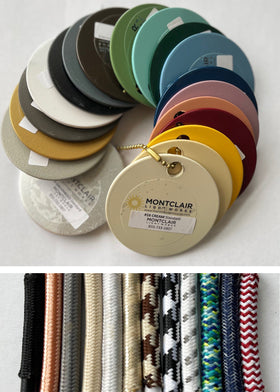
Most lighting disappointments share a single root cause: the fixture was designed for nobody in particular. Custom lighting is the corrective. It refers to light fixtures that are configured or built to match the specific requirements of a particular space — its dimensions, its finish palette, its ceiling height, its light quality needs — rather than pulled from a shelf and hoped to fit.
That definition matters because the term gets used loosely. A retailer offering two finish colours is not the same as a manufacturer that builds your fixture after you place the order. Understanding what build-to-order production actually means changes how you shop for lighting. This guide covers the core concepts every homeowner needs before making a decision.
Definition: What Is Custom Lighting?
Custom lighting is a light fixture that is configured or fabricated to meet the specific requirements of a particular space — including dimensions, finish, cord or stem length, shade interior colour, and light source — rather than sold as a fixed, mass-produced product. The key distinction is sequence: custom lighting is built around the buyer's requirements; standard lighting requires the buyer to adapt to the fixture.
Custom vs. Standard Lighting: The Core Difference
Standard lighting is designed for mass production. A manufacturer decides on a shape, a finish, a cord length, and a shade size — then produces thousands of identical units before a single customer exists. The homeowner's job is to find the closest match to what they actually need.
Custom lighting reverses that sequence. The customer's space and preferences come first; the fixture is configured or built around them. At a domestic build-to-order manufacturer, that configuration can range from selecting a powder-coat colour to specifying cord style, stem length, arm length, shade interior finish, and LED colour temperature — all within a single order.
The practical stakes are real. A pendant hung too low in a kitchen becomes a hazard. A shade finish that reads as warm bronze in a catalogue photo can look entirely different under the light conditions of your specific room. Standard fixtures require the homeowner to adapt. Custom fixtures adapt before they leave the workshop.
Custom vs. Standard: Side-by-Side
|
Factor
|
Custom / Build-to-Order
|
Standard / Mass-Produced
|
|
Production sequence
|
Made after your order is placed
|
Made before you exist as a customer
|
|
Finish options
|
Full palette, colour matching possible
|
2–4 fixed options
|
|
Dimensions
|
Cord length, arm length, stem height configurable
|
Fixed — what you see is what ships
|
|
Shade interior
|
Specifiable — can contrast with exterior
|
Pre-determined by manufacturer
|
|
Marine-grade finish
|
Available on request
|
Rarely offered
|
|
LED colour temp
|
Adjustable (e.g. 2700K–3500K flip switch)
|
Fixed at manufacture
|
|
Lead time
|
Longer — built after order
|
Shorter — ships from stock
|
|
Best for
|
Renovation planning, specific architectural requirements
|
Quick replacement, budget-driven projects
|
What Can Actually Be Customised?
This is where most homeowners are surprised — both by how much is possible and by how much variation exists between manufacturers. Not every brand that uses the word 'custom' builds in-house. The depth of genuine configurability depends entirely on whether fabrication happens under the same roof as the order desk.
At Montclair Light Works — a family-owned, US build-to-order manufacturer operating from a single facility in Southern California for over thirty years — the verified customisation options include:
Cord Style and Length
Pendant cord styles and cord lengths are adjustable to suit ceiling height and architectural context. The gap between a standard-length cord and a correctly proportioned one is immediately visible in a finished room — and impossible to fix without replacing the fixture.
Stem Length
Pendant stem lengths are configurable for situations where a rigid stem is preferred over a cord. Critical for kitchen islands, dining tables, and spaces where the fixture needs to sit at a precise height relative to a surface.
Wall Mount Arm Length
Wall mount arm lengths can be specified. This matters significantly in narrow hallways, stairwells, or on walls where the fixture's projection needs to clear trim or cabinetry without creating an obstruction.
Exterior Finish — Powder Coat
Custom powder coat finishes, including colour matching, allow a fixture to align precisely with existing metalwork — door hardware, plumbing fixtures, cabinet pulls. Polyester powder coat, the standard in quality domestic production, provides both colour retention and scratch resistance over time.
Opposing Finishes: Shade Interior, Canopy, and Arm
Shade interior, canopy, and arm finishing can each be specified independently. A fixture with a dark exterior shade and a white or contrasting interior is a different visual and functional object from one finished uniformly — the contrast affects both the aesthetic and the quality of reflected light.
Marine-Grade Finishing
For coastal homes, covered outdoor spaces, or any environment where salt air or sustained moisture is a factor, standard finish is not adequate. Marine-grade finishing is a genuine specification — not a marketing label — and is one of the more meaningful distinctions available from manufacturers who offer it.
Integrated LED Colour Temperature
Adjustable colour temperature — the range between the warm 2700K glow associated with incandescent light and the crisper 3500K suited to task-focused areas — can be handled with a flip switch on current integrated LED panels. No separate dimmer installation, no bulb change required.
Browse the full range of fixture types, collections, and finish options currently available.
Understanding LED Colour Temperature: 2700K vs. 3500K
Colour temperature is measured in Kelvin (K) and describes the warmth or coolness of the light a fixture emits. It has no effect on brightness — that is measured in lumens. Two fixtures at identical lumens can feel completely different depending on their Kelvin rating.
The choice between 2700K and 3500K is one of the most consequential decisions in a custom lighting specification — and one of the least understood. Here is what each delivers:
|
Attribute
|
2700K — Warm White
|
3500K — Neutral White
|
|
Visual tone
|
Amber/golden — similar to incandescent
|
Clean white — balanced and crisp
|
|
Atmosphere
|
Relaxed, intimate, cosy
|
Alert, task-ready, modern
|
|
Best rooms
|
Bedroom, living room, dining room
|
Kitchen, home office, utility areas
|
|
Skin tones
|
Very flattering — warm and natural
|
Accurate — good for vanity/bathroom
|
|
Food appearance
|
Rich and warm — excellent for dining
|
Accurate colour rendering for prep areas
|
|
Closest analogue
|
Traditional incandescent bulb
|
Halogen or cool-warm LED
|
|
MLW flip-switch
|
✓ Available on integrated LED fixtures
|
✓ Available on integrated LED fixtures
|
Key fact
Colour temperature does not affect brightness. A 2700K fixture and a 3500K fixture rated at the same lumens will illuminate the same area — they will simply feel different. Montclair Light Works integrated LED fixtures allow you to switch between 2700K and 3500K with a single flip of a switch, so you are not locked in at the point of purchase. (Source: Feit Electric Colour Temperature Guide; Montclair Light Works About Us page)
Why Build-to-Order Manufacturing Changes the Equation
'Build-to-order' has a specific operational meaning worth understanding. A build-to-order manufacturer does not hold finished inventory. When an order is placed, the fixture is fabricated — shades spun, arms bent, finishes applied, components assembled. What ships was made for that order, not for a warehouse shelf.
Three practical consequences follow from this for the buyer:
-
The product is current. There is no warehouse of old stock being cleared. The catalogue reflects what the workshop is currently producing to its current quality standard.
-
Modifications are possible. Requesting a specific stem length or powder-coat colour match is a production decision when the fixture has not yet been made. This is impossible with imported finished goods.
-
Quality accountability is concentrated. When the same team takes your order and fabricates the fixture, the relationship between what you specify and what arrives is short and direct. Montclair Light Works has operated this way from Southern California for over thirty years — continuity that only makes commercial sense when quality is the genuine competitive foundation.
The trade-off is lead time. A build-to-order fixture takes longer to reach you than one pulled from warehouse stock. For homeowners planning a renovation or deliberate redesign, that lead time is factored in from the start. For someone needing an urgent replacement, it is not the right model.
The Custom Lighting Market in 2026: What the Data Shows
The shift toward customisable, build-to-order decorative lighting is not a niche movement — it reflects a broader market transition that multiple independent research sources have now documented.
|
Metric
|
Value
|
Source
|
|
US decorative lighting market (2025)
|
$36.59 billion
|
Research and Markets, March 2026
|
|
US market projected value (2033)
|
$56.72 billion
|
Research and Markets / GlobeNewswire
|
|
US market CAGR 2025–2033
|
5.63%
|
Research and Markets, March 2026
|
|
Global decorative lighting market (2025)
|
$42.85 billion
|
SkyQuest, March 2026
|
|
North America market share (2025)
|
37.6% of global market
|
IMARC Group, 2026
|
|
Key growth driver cited
|
Shift toward customised lighting solutions
|
Multiple reports, 2025–2026
|
2026 lighting trend forecasters — including Hammerton Studio, Color Cord Company, and MOD Lighting — have independently identified the same structural shift: purpose-built and customisable fixtures are becoming an architectural mainstream expectation, not a luxury exception. As Color Cord Company noted in January 2026, there has been a measurable increase in custom requests that deliver purpose-built fixtures for very specific spaces.
Where Custom Lighting Fits in a Home Design Plan
Custom lighting is not the right answer for every fixture in a home. Most spaces benefit from a combination: architectural lighting — recessed, track, or under-cabinet — that handles functional illumination, and decorative fixtures that define the character of the space. Custom is most valuable at the latter.
The moments where a standard fixture will always be a compromise:
- A pendant over a kitchen island where standard cord lengths fall short of the correct hang height
- A wall light in a hallway with non-standard ceiling height where projection needs to be precise
- An outdoor gooseneck on a barn facade where specific proportional requirements matter to the architecture
- A coastal installation where standard finishes will degrade within one or two seasons of salt air exposure
- Any space where the existing metalwork — hardware, plumbing fixtures, cabinetry pulls — has a specific finish that generic options cannot match
The mistake most homeowners make is treating lighting as the final decision in a renovation rather than one of the earlier ones. Fixtures set scale, define the finish relationships between hardware and furniture, and establish whether a room reads as warm or crisp. Making that decision under deadline pressure leaves standard catalogue fixtures in spaces that warranted something made to measure.
If you want to see exactly what can be configured for your project, explore Montclair Light Works' full customisation options and speak directly with the team that builds every fixture.
What 'Artisan' Actually Means in US Lighting Manufacturing
The word 'artisan' is widely used in decorative lighting — and widely over-used. In a genuine domestic production context, it implies handwork at the fabrication stage: shades formed on a spinning lathe from aluminium rather than stamped by machine, arms shaped by a craftsperson with direct knowledge of how metal behaves under bending force.
Montclair Light Works shades are spun from heavy-duty aluminium. Arms are bent in-house. Polyester powder coat is applied at the same facility where the fixture was assembled. These are verifiable process facts — not positioning language.
US manufacturing adds an accountability layer that long offshore supply chains structurally cannot match. When a specification needs confirming before production, that conversation happens directly and quickly. When a finish question arises, the answer does not require waiting for a factory contact six time zones away.
The practical argument for American-made artisan lighting is logistical and qualitative — not merely patriotic. Finish durability under UV exposure, connection integrity through years of thermal cycling, shade retention of form under real-world conditions: all are answers provided by material selection and workmanship standards that are more verifiable when production is domestic and accessible.
Conclusion
Custom lighting, at its clearest, is a light fixture built around your space rather than a space adapted around a fixture. It means configuring finish, scale, and light quality to match a specific set of conditions — not accepting the nearest available approximation.
The specification process — working through finish, arm length, shade interior, colour temperature — is the work that standard retail eliminates and that a well-equipped build-to-order manufacturer makes straightforward.
See how Montclair Light Works builds every fixture to order, and find out what can be configured for your home.
Frequently Asked Questions
The questions below reflect real phrasing used in search engines and AI assistants. Each answer is written to be self-contained and directly quotable.
What is custom lighting for a home?
Custom lighting refers to fixtures that are configured or fabricated to meet the specific requirements of a particular space — including dimensions, finish, cord or stem length, shade interior colour, and light source — rather than sold as a fixed, mass-produced product. For residential applications, this typically means selecting from a range of verified configuration options at the time of order. The depth of what can be changed varies significantly between manufacturers depending on whether they build in-house.
What is the difference between custom and standard lighting?
Standard lighting is designed and manufactured before a buyer exists — the fixture is identical regardless of who purchases it or where it is installed. Custom or made-to-order lighting is configured after an order is placed, with finish, proportions, and light source matched to the buyer's requirements. Standard fixtures require the space to accommodate them; custom fixtures are built to accommodate the space.
What can be customised on a made-to-order light fixture?
At a domestic build-to-order manufacturer, typical configuration options include: cord style and length, pendant stem length, wall mount arm length, exterior and interior shade finish (including opposing finishes on shade interior, canopy, and arm), custom powder coat colour matching, marine-grade finishing for outdoor and coastal environments, and integrated LED colour temperature selection. The full range is only available when fabrication happens in-house.
Are made-to-order light fixtures worth it?
For spaces with specific ceiling heights, finish requirements, or dimensional constraints that standard fixtures cannot accommodate cleanly, a made-to-order fixture avoids the accumulated compromises of forcing a standard product into a space it was not designed for. The trade-off is lead time — build-to-order production takes longer than shipping from warehouse stock. For homeowners planning ahead, that lead time is factored in. For urgent replacements, it is not the right model.
What does 'build-to-order' mean for a light fixture?
A build-to-order manufacturer does not hold finished inventory. The fixture is fabricated — shade spun, arm bent, finish applied, components assembled — after the order is placed. Modifications are possible because production has not yet occurred, and the product that ships was made specifically for that order rather than pulled from pre-manufactured stock.
What is the difference between 2700K and 3500K light?
Colour temperature is measured in Kelvin (K) and describes the warmth or coolness of emitted light — not its brightness. 2700K produces a warm, amber-toned light similar to a traditional incandescent bulb, well suited to living rooms, bedrooms, and dining areas. 3500K produces a cleaner, more neutral white light better suited to kitchens, task areas, and workspaces. Some integrated LED fixtures allow switching between the two with a flip switch, so the homeowner is not locked into one colour temperature at the point of purchase. (Source: Feit Electric Colour Temperature Guide)
Does Montclair Light Works offer free shipping?
Montclair Light Works offers free shipping on small parcel shipments. This applies to the majority of their residential fixture range. Confirm shipping terms for your specific order at the time of purchase, particularly for larger or freight-classified items.