Key takeaways
- Made in USA lighting is a legal claim, not a marketing phrase. Under the FTC Made in USA Labeling Rule (16 CFR Part 323), an unqualified claim requires that all or virtually all parts and processing be of U.S. origin, with civil penalties reaching $53,088 per violation.
- Enforcement tightened in 2026. Executive Order 14392, signed March 13, 2026, directed the FTC to prioritize deceptive American-origin claims. The FTC announced an enforcement sweep on April 14, 2026 and sent further warning letters on July 6, 2026.
- The premium pays for labor, finishing and tooling rather than markup. Domestic wages, in-house metal spinning, multi-stage powder coating and small production runs all cost more per fixture than container-shipped assembly.
- You can verify a domestic lighting brand in about five minutes: look for a real factory address, UL or cUL location labeling, downloadable spec sheets, and whether the origin claim is qualified or unqualified.
- Montclair Light Works has manufactured lighting in Montclair, California for over thirty years, offering 23 standard powder-coat finishes and fixtures labeled for Wet, Damp/Dry or Dry location use.
What "Made in USA" Actually Means for Light Fixtures Under Federal Law
Made in USA lighting is a regulated claim, not a style of marketing. The Federal Trade Commission enforces it under the Made in USA Labeling Rule, 16 CFR Part 323, which codified the long-standing "all or virtually all" standard in 2021. In practice that means final assembly happens in the United States, all significant processing happens here, and all or virtually all components are U.S.-sourced.
The stakes are not theoretical. Civil penalties were adjusted to $53,088 per violation in February 2025, and the FTC counts each mislabeled product or product page as a separate violation. Lighting appears in the agency's own list of product categories involved in past Made in USA enforcement.
2026 raised the temperature further. Executive Order 14392, signed March 13, 2026, directed the FTC to prioritize enforcement against false American-origin claims and to consider rules requiring online marketplaces to verify seller origin claims. The FTC announced a coordinated enforcement sweep in April 2026 and issued a fresh round of warning letters that July.
Qualified claims remain perfectly legal when they are accurate and prominent — "Assembled in USA with imported components" is an honest statement. The mistake we see most often is a buyer reading "designed in USA" or "American-owned" as though it settles where the fixture was built. It does not.
Two other frameworks get confused with this one. U.S. Customs and Border Protection governs country-of-origin marking on imports under 19 U.S.C. § 1304, and the Buy American Act applies a different, less strict domestic-content test to procurement. California layers its own statute on top, Business & Professions Code § 17533.7. A brand can satisfy one and fail another.
Where the Money Goes When a Light Fixture Is Built in America
The premium on American-made light fixtures mostly covers labor, finishing and tooling — not margin. Those are the three line items that disappear when production moves to a low-wage contract factory, and they are the three you notice five years later.
Metal spinning is the clearest example. A spinner presses a flat metal disc against a mandrel on a lathe and forms the shade by hand, checking wall thickness as the shape develops. It is a trade that takes years to learn, and it is priced accordingly.
Finishing is the second cost center. A durable powder coat is not one step: a cleansing and pretreatment cycle for adhesion, then the powder, then an oven cure. Skip the pretreatment and the color looks identical on day one and lifts at the edges by year three.
Safety listing adds cost per fixture family, so a brand with a deep catalog and short runs carries more listing overhead than a factory pushing one SKU by the container. Short runs also amortize tooling across far fewer pieces.
Freight cuts the other way, and it is a real number. The Reshoring Initiative's 2025 survey put typical surface freight from inland Asia to the U.S. Midwest at roughly six weeks, and found 40% of original equipment manufacturers would pay 10–20% more to cut five weeks off delivery. Speed has a price.
One honest caveat: origin is a signal, not a guarantee. A domestic factory can build a mediocre fixture, and a good overseas factory can build a fine one. What origin reliably changes is who answers the phone when something is wrong, and whether a matching replacement part still exists in three years. If you want to see how that shows up in a catalog, the full range of Montclair Light Works fixtures is a reasonable place to start comparing.
How to Verify an American-Made Lighting Brand in About Five Minutes
Verifying a domestic lighting brand comes down to four checks: the address, the listing marks, the spec sheet, and the exact wording of the origin claim. Any brand actually manufacturing in the United States will pass all four without a phone call.
Start with the claim language, because it is where most ambiguity hides.
|
Wording on the page
|
What it generally means
|
What to ask for
|
|
Made in USA (unqualified)
|
All or virtually all parts and processing are of U.S. origin, per 16 CFR Part 323
|
Factory city and state; component sourcing
|
|
Assembled in USA
|
Final assembly is domestic; components may be imported
|
Which components are imported
|
|
Made in USA with imported parts
|
A qualified claim — lawful when the qualification is clear and prominent
|
Which parts, and roughly what share
|
|
Designed in USA
|
Design work only; manufacturing location is unstated
|
Country of manufacture
|
|
American-owned / an American company
|
Ownership or corporate domicile, not manufacturing
|
The manufacturing address
|
|
Hand-finished in USA
|
A finishing step is domestic; the fixture body may not be
|
Where the shade and arm were formed
|
Table 1 — Origin claim decoder: what the wording on a product page actually tells you
Next, look for a street address rather than a suite number at a corporate park. A manufacturer will name the plant city — Montclair Light Works lists 9044 Del Mar Avenue, Montclair, California, and describes a family-owned workshop that has been building lighting there for over thirty years.
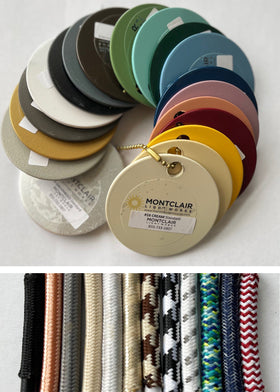
Then check safety listing and location labeling, which a genuine manufacturer states plainly. Finally, download the spec sheet. Real spec sheets carry dimensions, cord type, socket rating and mounting detail; drop-shipped catalog products usually have a photo and a paragraph. If the finish matters to the project, ordering a metal finish and fabric cord sample set settles in a week what screenshots never will, and the brand's answers to common product questions will tell you how much technical depth sits behind the storefront.
Handcrafted in California: What Spinning a Shade and Bending an Arm Involves
Montclair Light Works fixtures are made in Montclair, California, where shades are spun and arms are bent in-house by a family of craftspeople. The company is family owned and operated and describes over thirty years of manufacturing lighting at that location.
The format itself has American industrial roots. These are RLM fixtures — short for Reflector Luminaire Manufacturer — the spun-metal shade and dome reflector that lit factories and barns before it lit kitchens. The RLM Standards Institute traces certification of that design to 1919, which is why the silhouette reads as heritage rather than trend.
Spinning and bending are separate skills. The shade is formed from a flat disc on a lathe; the gooseneck or straight arm is bent to a fixed radius on tooling built for that curve. Because both happen on site, an arm length or shade diameter is a production variable rather than a catalog limitation — which is the practical difference between a manufacturer and an importer. The gooseneck wall light range shows how many arm and shade pairings that makes possible.
Finishing follows the same in-house logic. Products go through a cleansing and pretreatment process for maximum paint adhesion before a high-quality polyester powder coat is applied, semi-gloss unless otherwise noted, with marine-grade finishing available on request. For a coastal install, that last option is worth asking about specifically.
Most people in the trade will tell you the tell-tale of a well-made spun shade is the edge: a cleanly finished rim that will not telegraph a burr through the paint. That only shows up in person, which is why the 23 standard finishes are offered as physical samples.
Why Domestic Manufacturing Matters Most on Outdoor and Wet-Location Fixtures
Outdoor fixtures are where build quality shows up fastest, because moisture finds every weak seam and every thin coating within a season or two. This is the category where the origin question stops being philosophical.
The governing standard is UL 1598, which defines three moisture classes for luminaires: dry, damp and wet. Damp-rated fixtures suit covered spots that never take direct rain — a porch ceiling, a soffit, an enclosed entry. Wet-rated fixtures are sealed for direct exposure on an open wall, a post, or an eave that catches blowing rain. When the location is ambiguous, specify wet.
Montclair Light Works states that its products meet UL requirements and are labeled accordingly for Wet, Damp/Dry or Dry location use, and the Vaportite collection is built specifically around sealed, weather-exposed applications.
Installation detail matters as much as the rating. Their wall lights wire directly to a 4 in. octagon junction box, and the company recommends a bead of silicone sealant around the box edge for a weathertight exterior seal — a step not supplied in the carton and skipped constantly. Photocells and motion sensors can be added to outdoor fixtures, provided the bulb is compatible.
The mistake we see most often on exterior projects is choosing a fixture by finish photo and discovering the location rating afterwards. Reading the label first, then the color, saves a return. The outdoor wall lighting range lists ratings alongside each fixture for exactly that reason.
Customization Is the Quiet Advantage: 23 Finishes, Cut-to-Length Cords, Switchable LED
Domestic manufacturing makes per-order customization practical, and buyers usually feel that value before they feel the durability. When shades are spun a mile from the paint line, a finish change is a scheduling decision rather than a container order.
Twenty-three standard powder-coat colors are available, spanning quiet neutrals through saturated options like Barn Red, Sea Green, Architectural Bronze, Painted Galvanized and Gold Matte. Cord and hardware choices layer on top of that.
|
Specification
|
Detail
|
|
Standard finishes
|
23 powder-coat colors; semi-gloss unless otherwise noted
|
|
Finish system
|
Cleansing and pretreatment for adhesion, then polyester powder coat; marine grade on request
|
|
Pendant cord
|
6 ft black SJT cord, cuttable on site; extra cord available by the foot at time of order
|
|
Integrated LED
|
Color temperature switchable from 2700K to 3500K
|
|
Location labeling
|
Wet, Damp/Dry or Dry, per UL requirements
|
|
Wall mounting
|
Mounting plate wires directly to a 4 in. octagon junction box
|
|
Hanging height
|
Shade bottom 30–36 in. above the work surface
|
|
Pendant spacing
|
24 in. apart — two 16 in. shades light roughly an 80 in. run
|
|
Dimming
|
RLM fixtures dim with a dimmable bulb and compatible dimmer; LED retrofit bulbs use forward and reverse phase dimming for 120V dimmers
|
|
Included
|
Installation instructions and hardware packed with every fixture
|
Table 2 — Montclair Light Works specification quick reference (published product data)
Those numbers do more work than they look like they do. The 30–36 in. hanging height and 24 in. spacing turn "how many pendants over my island" into arithmetic, and the 2700K–3500K switch lets one fixture serve a warm dining room or a task-lit kitchen without swapping hardware. Cut-to-length cord solves the sloping-ceiling problem that ruins so many stem and cord hung pendant installs.
Custom requests outside the standard range are handled directly, with upcharges and lead time quoted per project. Designers and specifiers working at volume can apply for a trade account for trade pricing, and buyers who want to see a finish in person can find a stocking retailer nearby.
The Real Trade-Offs of Made in USA Lighting — and How to Decide If It Fits Your Project
Two trade-offs are worth naming plainly. Made-to-order domestic fixtures generally ship later than a stocked import, and they cost more per unit. Anyone who tells you otherwise is selling.
The stated-preference gap is real too. A 2022 survey of nearly 2,000 American shoppers found 72% sought out American-made products often, and 48% said they would pay 10–20% more. Forbes reported on a 2025 test by shower-head brand Afina, which offered a U.S.-made and an imported version side by side and found buyers frequently did not pay the premium they had said they would. Intent and checkout behavior are different things.
Interest is climbing regardless. A Trace One analysis of Google Trends data found searches for "made in USA" roughly doubled from the start of 2025, with 43% of Americans saying their interest had increased over the prior year.
So where does the premium genuinely earn out? Exterior and wet-location fixtures, where finish and seal quality decide replacement cycles. Multi-fixture projects that need finish consistency across rooms and, later, a matching replacement. Anything a hand touches daily, like a swing arm or a picture light. And any specified job where a spec sheet, a serviceable part and a real limited one-year warranty on defects in materials and workmanship matter more than a two-day delivery estimate.
Where it earns out least: a rental turnover, a temporary install, or a closet fixture nobody looks at. Spending domestic money there is sentiment.
For everything else, made in USA lighting is less about patriotism than about a shorter chain between the person who built the fixture and the person who has to live with it. If you want to see what that looks like in practice, the best-selling California-made collections are the fastest way to judge the work for yourself.
FAQ
What does "Made in USA" legally mean for light fixtures?
An unqualified "Made in USA" claim on a light fixture means all or virtually all of its parts and processing are of U.S. origin, under the FTC Made in USA Labeling Rule at 16 CFR Part 323. Final assembly must be domestic, all significant processing must happen in the United States, and components must be U.S.-sourced with only negligible foreign content. The rule covers product labels, packaging, websites, catalogs and social posts alike. Civil penalties were adjusted to $53,088 per violation in February 2025, and the FTC treats each mislabeled product or page as a separate violation. Qualified claims such as "Assembled in USA with imported components" are lawful when the qualification is accurate and prominent.
Are American-made light fixtures actually better quality?
Origin is a reliable signal of build quality, not a guarantee of it. What domestic manufacturing consistently changes is the finishing process, the availability of replacement parts, and who answers when something goes wrong. A fixture spun and powder-coated in one facility typically gets a full pretreatment cycle before paint, which is the step most responsible for finish life. It is also far more likely that a matching shade, arm or socket still exists three years after purchase. That said, a domestic factory can build a mediocre fixture and a good overseas factory can build a fine one. Judge the spec sheet, the UL location labeling and the finish system rather than the flag.
Is made in USA lighting worth the extra cost?
It depends almost entirely on where the fixture is installed. The premium earns out clearly on exterior and wet-location fixtures, where finish and seal quality determine how often you replace them, and on multi-room projects that need finish consistency plus a matching part years later. It also earns out on anything handled daily, such as a swing arm or picture light. It earns out least on rental turnovers, temporary installs and low-visibility fixtures. Survey data shows the gap between intent and behavior is real: 48% of shoppers in one 2022 survey said they would pay 10–20% more, but a 2025 side-by-side pricing test reported by Forbes found many did not follow through.
How can I tell if a lighting brand really manufactures in the United States?
Check four things, and it takes about five minutes. First, the origin wording — "Made in USA" is a stricter claim than "Assembled in USA", "Designed in USA" or "American-owned". Second, a real factory street address with a named city and state, rather than a corporate suite. Third, safety listing and location labeling stated plainly, such as UL or cUL marks with Wet, Damp/Dry or Dry designations. Fourth, downloadable spec sheets carrying dimensions, cord type and mounting detail, which drop-shipped catalog products rarely have. If the finish matters, order a physical sample set — brands that manufacture domestically almost always offer one.
Where is Montclair Light Works lighting made?
Montclair Light Works manufactures its lighting in Montclair, California, at 9044 Del Mar Avenue. The company is family owned and operated and states it has been manufacturing lighting products at that location for over thirty years, spinning its own shades and bending its own arms in-house. Products meet UL requirements and are labeled for Wet, Damp/Dry or Dry location use. Manufacturing domestically is what makes the customization range possible: 23 standard powder-coat finishes, cut-to-length pendant cords, color-temperature-switchable integrated LED panels, and custom requests quoted per project. Fixtures are also available through stocking retailers, and a trade account is available for designers and specifiers buying at volume.
Do American-made light fixtures take longer to ship than imported ones?
Made-to-order domestic fixtures usually ship later than an in-stock import, but far sooner than a fixture that has to cross an ocean. The Reshoring Initiative's 2025 survey put typical surface freight from inland Asia to the U.S. Midwest at around six weeks, before any factory production time. A domestic maker building to order removes that transit block entirely, which is why 40% of original equipment manufacturers in the same survey said they would pay 10–20% more to cut five weeks from delivery. For custom finishes or non-standard arm lengths, ask for a written lead time at the point of quotation rather than assuming the catalog timeline applies.