Key takeaways
- Handcrafted lighting fixtures are shaped one at a time by an operator — most often by metal spinning, where a flat metal disc is pressed over a mandrel on a lathe. Mass-produced fixtures are punched or drawn in a hard die that stamps an identical part every cycle.
- The die is what drives the price gap. Hard tooling costs a great deal upfront but runs far faster, so per-unit cost falls sharply at high volume. Spinning tooling is cheap, which is why short runs, custom sizes and one-off finishes stay economically possible.
- Finish separates the two faster than form does. Industry testing places polyester powder coat over pretreated metal at roughly 500–1,000 hours in ASTM B117 salt spray, against roughly 300–750 hours for wet paint with primer.
- Handcrafted means made to order, which means no warehouse of ageing stock — and a longer wait. That trade-off is the honest cost of the model, not a flaw in it.
- Montclair Light Works spins its own shades and bends its own arms in Montclair, California, and has manufactured lighting there for over thirty years.
What "Handcrafted" Actually Means on a Light Fixture Product Page
The difference between mass-produced and handcrafted lighting fixtures is a manufacturing decision, not a marketing tone. Handcrafted means a person shapes and finishes each piece using tooling that guides rather than replaces their judgement. Mass-produced means a die or an automated cell produces an identical part every cycle with minimal human input.
In decorative metal lighting that distinction usually comes down to one thing: how the shade was formed. A handcrafted shade is typically spun — a flat metal disc rotates on a lathe while an operator presses it over a mandrel with a forming tool, working the metal into shape in passes. A mass-produced shade is stamped or deep-drawn, punched into final form by a press.
Both are legitimate engineering. Neither is inherently dishonest. What matters is that they produce different outcomes in cost, catalog breadth, lead time and finish consistency — and that "handcrafted" is not a regulated term the way country-of-origin claims are.
That last point is worth sitting with. Because nobody polices the word, some sellers apply it to fixtures that were die-formed overseas and hand-assembled in a warehouse. The mistake we see most often is a buyer treating "handcrafted" and "hand-assembled" as the same claim. Assembly is the last twenty minutes of a fixture's life; forming and finishing are the parts that decide how it ages.
If origin is also part of your decision, treat it as a separate question. "Made in USA" is a regulated advertising claim with a specific federal standard behind it, and it is worth settling before comparing two fixtures on craft alone.
How a Hand-Spun Shade Is Made — and Why the Method Shows in the Result
Metal spinning shapes a rotating blank over a mandrel using a hand-guided forming tool, building the shade in progressive passes rather than one impact. The operator controls how fast the metal moves and how much it thins, which is the whole skill.
Because pressure is applied gradually, the metal work-hardens as it forms and the operator can feel resistance change through the tool. Push too hard and the wall thins or wrinkles; too gently and the shape never sets. A spinner reads that feedback continuously — which is why the trade takes years rather than weeks to learn.
The format has deep American industrial roots. The spun-metal shade with a dome reflector is the RLM silhouette — RLM standing for Reflector Luminaire Manufacturer — the fixture type that lit factories, warehouses and barns before it moved into kitchens. The RLM Standards Institute traces certification of that design back to 1919.
Arms follow the same logic. A gooseneck or straight arm is bent to a fixed radius on tooling built for that curve, then welded and cleaned by hand. Montclair Light Works describes taking pride in each shade it spins and each arm it bends, worked by a family of craftspeople in a Montclair, California workshop running for over thirty years.
What you notice as a buyer is subtle and physical: a shade rim that reads as formed rather than cut, wall thickness that stays even from crown to edge, and a weld you have to look for. Those show up across the gooseneck wall light range more clearly than in any specification line.
Why Mass-Produced Fixtures Cost So Much Less: The Die Explains Everything
Mass-produced lighting is cheaper because a hard die runs fast enough to spread its own cost across an enormous number of parts. Once the die exists, each additional fixture is quick and nearly labor-free — a drawn or stamped part will almost always cost less per piece than a spun one at volume.
The catch is that the die freezes the shape. Changing a diameter, a depth or a profile means new tooling, which means new capital and new lead time. That is why an import catalog tends to be broad but fixed: every variant you can see already has a die behind it, and every variant you cannot see would need one built.
Spinning inverts the economics. Tooling is a mandrel rather than a matched die set, so it is comparatively cheap to make and cheap to change. Per-unit cost stays higher and cycle times stay slower, but a new size or a different arm length becomes a scheduling question rather than a capital project.
|
Factor
|
Hand metal spinning
|
Stamping / deep drawing
|
|
Tooling
|
A mandrel and forming tools — comparatively inexpensive
|
Matched hard dies — high upfront investment
|
|
Volume economics
|
Cost-effective for low and medium runs
|
Per-part cost falls sharply as volume rises
|
|
Cycle speed
|
Slower; operator-paced, one piece at a time
|
Much faster; press-paced and largely automated
|
|
Changing a shape
|
New mandrel — a scheduling decision
|
New die — significant cost and lead time
|
|
Minimum order
|
Small runs and single fixtures are viable
|
Volume commitments are usually required
|
|
What the buyer gains
|
Size, arm and finish flexibility; short-run availability
|
Lower price, immediate stock, broad fixed catalog
|
|
What the buyer gives up
|
Lead time and a lower price point
|
Any option the die was never cut for
|
Table 1 — How the two forming methods compare, and what each trade-off means for the buyer
Read that table as a set of trade-offs rather than a verdict. A builder fitting forty identical downlights should want the die. Someone matching a specific shade diameter to a specific island wants the mandrel. The way those choices play out across a real order is set out in the guide to made-to-order and custom lighting.
Finish Is Where the Difference Shows Up First
Coating quality, not shape, is usually the first place a cheap fixture gives itself away — and it is the one difference you can put numbers against. A finish fails at the edges and seams long before the metal underneath does.
A durable powder coat is a sequence, not a step. The part is cleaned and chemically pretreated so paint has something to key into, then powder is applied electrostatically, then it is cured in an oven so the coating flows and cross-links. Skip the pretreatment and the color looks identical on day one and lifts at the edges by year three.
|
Coating system
|
ASTM B117 salt spray (industry-reported)
|
Practical notes
|
|
Polyester powder coat over pretreated metal
|
Roughly 500–1,000 hours; higher with phosphate pretreatment
|
Thicker, more even film; better edge and chip resistance
|
|
Wet / liquid paint with primer
|
Roughly 300–750 hours depending on the system
|
Thinner film; coverage varies more at seams and radii
|
|
Coating with pretreatment skipped
|
Not meaningfully comparable
|
Adhesion is the failure point regardless of the topcoat used
|
Table 2 — Coating performance ranges reported in industry testing. These are category benchmarks, not measured results for any single fixture.
One caveat that most lighting content leaves out: ASTM B117, the standard practice behind those hours, states in its own scope that prediction of performance in natural environments has seldom been correlated with salt spray results used as stand-alone data. Treat the numbers as a way to compare coatings against each other, not as a lifespan promise.
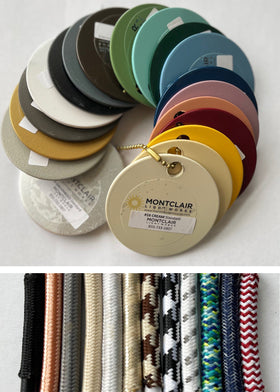
Montclair Light Works applies a polyester powder coat after a cleansing and pretreatment process for maximum paint adhesion, semi-gloss unless otherwise noted, with marine-grade finishing available on request. Color is where this gets genuinely enjoyable rather than technical — there are 23 standard finishes, and a physical sample set settles in a week what a screen never will.
Made to Order vs Made for a Warehouse: What Changes for You
Handcrafted production is almost always made to order, and that changes the buying experience more than most people expect. Nothing is pulled from a pallet; the fixture is fabricated after you specify it.
Three practical consequences follow. Your fixture is built to the workshop's current standard rather than to whatever it was three years ago when a container shipped. There is no ageing stock to clear, so the catalog reflects what is actually being produced. And accountability is concentrated — the team that took the order made the part.
The cost is time. A made-to-order fixture takes longer to arrive than one sitting in a distribution center, because spinning, bending, coating, curing and assembly all happen after the order lands. For a renovation planned months out, that is a scheduling line item. For an urgent replacement before guests arrive on Friday, it is the wrong model, and it is fair to say so.
The upside is that specification stops being a compromise. Pendant cord arrives as a 6 ft black SJT cord that can be cut on site, with extra cord available by the foot at time of order. Integrated LED panels switch between 2700K and 3500K, so one fixture serves a warm dining room or a task-lit kitchen. Mounting guidance is published rather than guessed: the site FAQ puts the bottom of the shade 30–36 in. above the work surface, with pendants 24 in. apart, so two 16 in. shades light roughly an 80 in. run — arithmetic that makes planning a row of stem hung pendants straightforward.

Six Things to Check in Person Before You Decide
You can tell a hand-formed fixture from a stamped one in about a minute of handling, and none of the checks require tools. The tells are all at the edges, the joints and the back.
Start with the rim of the shade. A spun shade usually has a rolled or cleanly finished edge with consistent thickness; a thin stamped shade often has a sharper cut edge where the coating is at its most fragile. Run a fingertip around it.
Then weigh it in your hand relative to its size. Thicker gauge metal feels heavier and rings lower when tapped — a tinny sound usually means thin material. Look next at the inside of the shade near the socket, where cheap fixtures show overspray, bare metal or glue.
Check the joints. Threaded connections should engage smoothly and hold position without shimming, and a weld should be ground flat enough that you have to hunt for it. Then check the backplate and mounting hardware, which is where cost-cutting is least visible in photographs and most obvious in your hands — a proper wall light mounts to a 4 in. octagon junction box with hardware and instructions in the carton.
Finally, look for the safety label. Montclair Light Works states its products meet UL requirements and are labeled for Wet, Damp/Dry or Dry location use — and any fixture headed outdoors, like the sealed Vaportite fixtures, should say so on the label rather than in the description. If a fixture states no location rating at all, treat it as indoor-only.
When Mass-Produced Wins — and When Handcrafted Lighting Fixtures Earn Their Price
Mass-produced fixtures are the correct answer more often than craft marketing admits. Recessed cans, utility fixtures, closets, garages, rental turnovers, and any job needing forty identical units on a fixed budget are all cases where a die-formed fixture is the rational buy.
Standardization is a genuine feature in those situations. Identical parts mean predictable installs, easy replacements and no lead time. Paying a craft premium for a fixture nobody will look at twice is sentiment, not strategy.
Handcrafted pieces earn their price in the opposite conditions. Exterior and wet-location fixtures, where coating quality decides replacement cycles. Rooms where the fixture is at eye level and gets touched daily. Multi-room projects that need finish consistency now and a matching part in three years. And anything where a specific diameter, arm length or color is the point rather than a nice-to-have.
Most practitioners would tell you the deciding question is not "which is better" but "how visible and how exposed is this fixture". Answer that honestly per room and the budget allocates itself — spend on the four fixtures people notice, standardize the rest.
If you want to judge the work rather than the argument, spend ten minutes with the collections and the craftspeople behind them, or see which pieces are moving fastest in the current best sellers. What is being made in California right now is also worth reading alongside this year's lighting trends.
FAQs
What does "handcrafted" actually mean for a light fixture?
Handcrafted means a person shapes and finishes each fixture using tooling that guides their work rather than replacing it. In decorative metal lighting that usually means the shade is spun — a metal disc rotates on a lathe while an operator presses it over a mandrel in progressive passes — and the arm is bent, welded and cleaned by hand. It is different from "hand-assembled", which only describes the final stage of putting die-formed parts together. Unlike country-of-origin claims, "handcrafted" is not a regulated term, so no agency polices its use. The practical test is to ask how the shade was formed and where, rather than relying on the adjective.
What is a hand-spun metal shade?
A hand-spun shade is formed by pressing a flat metal disc over a shaped mandrel while it rotates on a lathe. The operator works the metal into shape across several passes, controlling how quickly it moves and how much the wall thins. Because pressure builds gradually rather than in one press stroke, the metal work-hardens as it forms, and the operator feels resistance change through the tool as it does. The result is a seamless, rotationally symmetrical shade with even wall thickness and a formed rather than cut rim. The spun shade with a dome reflector is the classic RLM silhouette, a design the RLM Standards Institute traces to 1919.
Why are mass-produced light fixtures so much cheaper?
Because a hard die spreads its own cost across an enormous number of parts and runs far faster than an operator can. Stamping and deep drawing require expensive matched tooling upfront, but once that tooling exists each additional fixture is quick and needs almost no labor, so per-unit cost falls sharply as volume rises. A stamped or drawn part will almost always cost less per piece than a spun one at scale. The trade-off is rigidity: the die fixes the shape permanently, so any size, depth or profile it was not cut for would need entirely new tooling. That is why import catalogs are broad but fixed.
Does handcrafted mean every fixture will look slightly different?
Small variation is possible, but it should be invisible in a finished install rather than obvious. Spinning is done over a fixed mandrel and finishing follows a controlled powder-coat process, so dimensions and color stay consistent across a batch; what varies is the kind of detail you would need calipers to find. If you are buying several fixtures for one room, the safest approach is to order them together so they are finished as one job rather than months apart. Ordering a physical finish sample set before you commit also removes the guesswork on color entirely.
How can I tell if a light fixture was hand-spun or machine-stamped?
Check the rim of the shade first — a spun shade usually has a rolled or cleanly finished edge with consistent wall thickness, while a thin stamped shade often shows a sharper cut edge where coating is weakest. Then weigh it relative to its size: thicker gauge metal feels heavier and sounds lower when tapped, and a tinny ring usually means thin material. Look inside near the socket for overspray, bare metal or glue. Threaded joints should engage smoothly without shimming, and welds should be ground flat enough that you have to look for them. Finally, check for a UL or cUL label with the location rating stated.
How long does a made-to-order light fixture take to build?
Longer than pulling stock from a warehouse, because every step happens after the order is placed. The shade is spun, the arm is bent and welded, the parts are cleaned and pretreated, the powder coat is applied and oven-cured, and only then is the fixture assembled, wired and packed. Lead time depends on the fixture, the finish and whether anything is non-standard, so the reliable move is to ask for a written lead time at the point of quotation rather than assuming a catalog estimate. Custom requests outside the standard range are quoted individually, with upcharges and timing confirmed per project.