Most rooms are lit. Far fewer are designed. The gap between the two almost always comes down to lighting — not the bulbs, and not the brightness, but the fixtures: their scale, their finish, their position in the room, and how they work together. This guide covers everything that matters when buying luxury lighting for a home, from understanding what genuinely distinguishes a high-end fixture to sizing chandeliers, choosing finishes, and layering light the way designers do.
Luxury lighting is not a category defined by price alone. It is defined by material quality, manufacturing precision, and the degree to which a fixture changes the character of a room when it is on — and when it is off. Start by exploring our full collection of luxury light fixtures to see what that standard looks like in practice.
Quick answer: Luxury lighting is defined by material quality, manufacturing precision, and design permanence — not price alone. To buy correctly, size chandeliers using the room formula (length + width in feet = diameter in inches) or the table formula (½ to ⅔ of table width), choose one dominant metal finish per room, and layer ambient, task, and accent light rather than relying on a single overhead fixture.
What Makes a Luxury Light Fixture Worth the Investment
A luxury light fixture earns that designation through several qualities working together. The first is material integrity. Hand-blown glass, forged brass, architectural bronze, natural stone, and solid crystal are not interchangeable with their mass-market equivalents — they age differently, catch light differently, and carry a visual weight that machine-produced alternatives simply cannot replicate.
The second is manufacturing precision. High-end fixtures are built to tight tolerances. Joints sit flush. Finishes are even. Proportions are deliberate. A fixture made carelessly shows itself the moment it is installed — in a seam that doesn't close cleanly or a shade that hangs slightly off-axis.
The third quality is design permanence. A luxury fixture is not made to look good for one season. The best pieces in the market right now — statement chandeliers in architectural bronze and blown glass — are rooted in design principles that have held up for decades, not trend cycles that last 18 months.
The global luxury lighting fixture market reflects this sustained demand: the segment was valued at USD 4.79 billion in 2026, with approximately 62% of consumers prioritizing luxury décor elements and around 54% of high-end residential projects incorporating designer lighting. That is not a niche preference — it is the mainstream expectation in premium homes.
Chandelier Sizing: The Formula Designers Actually Use
Chandeliers are where more buying mistakes happen than anywhere else in lighting. The two most common errors are polar opposites: a fixture so small it disappears into the ceiling, or one so large it overwhelms the furniture beneath it. Both are avoidable with a simple calculation, and the underlying formulas are the same ones taught throughout the lighting industry — including by the American Lighting Association, the trade organization behind most professional residential lighting design education in North America.
The room formula: Add the length and width of the room in feet, then convert that number to inches. A 14-foot by 16-foot dining room (14 + 16 = 30) suits a chandelier approximately 30 inches in diameter. This is a starting point, not a ceiling — rooms with more vertical height, higher ceilings, or dramatic architecture can support slightly larger fixtures.
The table formula: For dining rooms specifically, the chandelier diameter should fall between one-half and two-thirds the width of the dining table. A 48-inch-wide table calls for a fixture between 24 and 32 inches across. The chandelier should not extend beyond the table edges — guests should be able to see each other across the table without the fixture obstructing the sightline.
Hanging height: For standard 8-foot ceilings, the bottom of a dining chandelier typically sits 30–36 inches above the table surface. Add 3 inches for every additional foot of ceiling height beyond 8 feet. In double-height foyers or stairwells, the right answer is always elongated or cascading forms — the fixture needs to fill vertical space without feeling heavy at the bottom.
For living rooms and great rooms, maintain at least 7 feet of clearance from the floor. Great lighting is contextual — the same fixture that soars in a double-height foyer disappears in an intimate bedroom.
The Three Types of Luxury Light Fixtures (and Where Each Belongs)
Luxury lighting encompasses several distinct fixture categories. Understanding what each type does — structurally and atmospherically — prevents the common mistake of over-relying on one at the expense of the others.
Chandeliers and Statement Pendants
These are the room's primary declaration. A chandelier anchors a space, defines its centre of gravity, and sets the scale for everything around it. Statement pendant clusters perform a similar function in kitchen islands, breakfast rooms, and double-height living areas, where a single chandelier would feel off-proportion.
Chandeliers held approximately 38–41% of the luxury lighting market in recent years — a consistent share that reflects how central they remain to high-end residential design. Browse our full chandelier collection to compare silhouettes, materials, and scale across residential and high-ceiling applications.
Wall Sconces
Sconces are experiencing a genuine design renaissance. Historically treated as afterthoughts flanking a mirror, they are now being selected with the same care as statement pendants — particularly gooseneck and swing-arm styles for bedrooms and living rooms. Wall sconces are earning more design attention in 2026, particularly swing arm and gooseneck styles in bedroom and living room applications.
A pair of sconces flanking a fireplace, a buffet, or a bed headboard creates bilateral symmetry that reads as deliberately architectural. They also solve a practical problem: in rooms where a ceiling fixture would feel imposing, sconces can carry the ambient load while adding warmth at eye level. Explore the full wall sconce collection to compare arm styles and shade shapes.
Pendants and Task Lighting
Over kitchen islands, pendants serve two masters simultaneously — they must provide task-level illumination for prep work and stand as design objects in their own right. The standard guidance is to space multiple pendants 24–32 inches apart, hang them 28–34 inches above the countertop, and leave 6 inches of clearance from the island's edge. For islands 6–8 feet long, three pendants typically provide the best combination of even light distribution and visual balance. See our stem hung pendant collection for island-ready options.
How to Choose a Finish: What the Trends Actually Mean for Your Home
Finish selection is where many buyers get lost, partly because the options are genuinely wide and partly because the advice available online is often contradictory. Here is what is actually happening in the market right now, and what it means for long-term purchasing decisions.
Architectural bronze — a deep, warm, slightly matte tone — has replaced polished brass as the warm-metal-of-choice for many designers. It reads as sophisticated without trying too hard, and it pairs naturally with warm wood tones, terracotta, and deep greens. This shift matters because architectural bronze is also more forgiving: it does not show fingerprints the way polished brass does and does not read as "dated" if the broader trend moves on.
Matte black is not going away, but its application has become more considered. The strongest 2026 approach is using it selectively — one statement piece, or a deliberate pairing against a warmer metal elsewhere — rather than outfitting an entire space in a single dark finish. See the full range of available finishes to compare undertones, textures, and how each reads under different light sources.
For mixed-metal schemes: anchor the space with one dominant finish and use one or two supporting metals as accents. Warm metals (brass, bronze, gold) and cool metals (chrome, nickel) generally work better within their own temperature family than across it. One finish appearing in at least three places in a room creates the repetition needed for the mix to read as intentional rather than accidental.
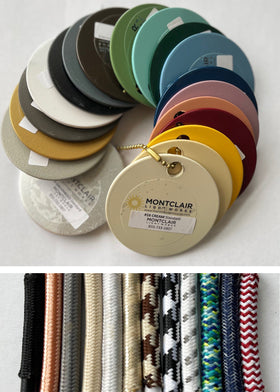
A practical note most guides omit: always request finish samples before committing to a fixture order. Photographs — even professional ones — do not accurately capture how a finish behaves under the specific light conditions of your room. Our metal finish and fabric cord sample set is built for exactly this step.
Layered Lighting: The Technique That Separates Designed Rooms from Decorated Ones
A room lit only by a central overhead fixture is a room that looks good in photographs and feels flat to live in. Layered lighting solves this by distributing light across three distinct functions.
Ambient light is the room's foundation — the overall, diffused glow that makes a space navigable and alive. In luxury interiors, ambient light rarely comes from a single ceiling source. It may come from a chandelier supplemented by recessed fixtures, or from wall sconces that wash light upward toward the ceiling plane.
Task light is directed and functional — pendant lights above an island, a reading lamp beside a chair, vanity lighting that eliminates shadows. It should be bright enough to work by but not so dominant that it competes with the room's overall atmosphere.
Accent light creates depth and drama. It highlights architectural features, artwork, shelving, and textural surfaces. A well-placed picture light or directional spotlight can transform a painting from decoration to destination.
Every exceptional lighting scheme begins with a framework of these three distinct layers that work in concert to create depth, function, and drama. Think of it as composing a room rather than simply decorating one.
In practical terms: most rooms benefit from at least one fixture in each category. The mistake is investing heavily in a statement chandelier and then treating task and accent lighting as budget afterthoughts — the result is a beautiful fixture in an otherwise flat room.
What the 2026 Luxury Lighting Trends Mean for Buyers
Understanding trend context helps separate durable choices from ones that will feel dated in three years. Here is what is genuinely moving in the luxury lighting market right now, and the distinction between what is a passing cycle and what is a lasting shift.
Sculptural and artisan fixtures are a lasting shift, not a trend. The move toward handcrafted pieces — hand-blown glass, hammered metals, stone-composite forms — reflects a broader consumer response to mass uniformity. Artisan lighting is no longer considered a design accent — it's becoming the foundation of luxury interiors. This will not reverse.
Natural materials in lighting — marble, travertine, rattan, wood — are also durable. They connect interior design to the biophilic principles that have been reshaping residential architecture for nearly a decade. A travertine pendant or a blown-glass dome does not become irrelevant when the next trend cycle arrives; it becomes a reference point.
Art Deco revival is trend-dependent and worth approaching with more caution. The clean angles, gilded metallics, and architectural confidence of Art Deco are back in vogue. The key to wearing this trend without looking like a costume is proportion and restraint — one strong Art Deco chandelier in a dining room, paired with clean-lined furniture and a warm neutral palette, reads as sophisticated. The same room with five competing period references reads as a history lesson.
Smart integration — dimmability, colour temperature control, voice compatibility — is a feature to specify wherever possible, independent of aesthetic direction. Today's luxury homeowners understand that brilliant interior design falls flat if the lighting is harsh, uneven, or outdated. The new standard is sophisticated layering, seamless smart-home integration, and fixtures that double as high-end art installations even when the lights are turned off.
For a deeper dive into what's shaping the market this year, see our companion post, Modern Lighting Trends for 2026: Styles, Finishes & Designs to Watch.
Room-by-Room Buying Priorities
Every room has different demands, and a buying decision that is correct for a dining room may be wrong for a bedroom. A brief breakdown of where to focus in each major space:
-
Dining room: The chandelier is the centrepiece. Invest here. Prioritise scale (the table formula above), dimmability, and a finish that coordinates with adjacent spaces. A fixture that cannot be dimmed in a dining room is a missed opportunity every evening.
-
Kitchen: Pendants over the island are the defining fixture, but they work harder when paired with under-cabinet task lighting and ceiling-level ambient sources. Do not make the pendants the only light in the room.
-
Living room: This is the space that most rewards a layered approach. A statement chandelier or large pendant for the room's centre, wall sconces at seated eye level, and table lamps or floor lamps to anchor seating groups. Together they allow the room to shift from daytime function to evening atmosphere.
-
Foyer and staircase: First impressions are set here. A generous fixture — larger than instinct often suggests — signals the quality of what follows throughout the home. In double-height entries, elongated or tiered chandeliers fill vertical space in a way that nothing else does.
-
Bedroom: Restraint is often the right call overhead, with real investment going into bedside wall sconces or swing-arm reading lights. The overhead fixture should be dimmable to its lowest setting; the reading sources should be bright enough to function without the overhead on at all.
Conclusion
Luxury lighting is a long-horizon investment. The right fixture does not simply illuminate a room — it defines the room's character, anchors its scale, and elevates the materials and furnishings around it. The decisions that matter most are not which fixture is trending this season, but whether the scale is right for the architecture, whether the finish reads well under your specific lighting conditions, and whether the layering plan distributes light across all three functions a room needs.
When you are ready to move from research to selection, shop our luxury lighting collections to explore chandeliers, pendants, sconces, and statement fixtures across the full range of finishes we carry — with guidance available for any room, budget, or architectural style.
Related Reading
FAQ
What is luxury lighting and how is it different from standard fixtures?
Luxury lighting refers to high-end fixtures distinguished by material quality (hand-blown glass, forged metals, natural stone, solid crystal), manufacturing precision, and design permanence. The difference from standard fixtures is visible in how joints sit, how finishes behave over time, and how the piece reads in a room when unlit — a genuinely well-made fixture functions as a sculptural object whether the bulbs are on or off.
How do I choose the right size chandelier for my room?
Add the room's length and width in feet and convert that total to inches — that figure gives you the ideal chandelier diameter as a starting point. For dining rooms, size the chandelier to the table: the diameter should fall between half and two-thirds the table's width. Hang dining chandeliers 30–36 inches above the table surface at standard 8-foot ceiling height, adding 3 inches per additional foot of ceiling height above that.
What are the best luxury lighting finishes for 2026?
Architectural bronze is the dominant warm-metal choice for 2026 — it pairs naturally with warm wood tones, terracotta, and neutral palettes while being more forgiving than polished brass in day-to-day use. Matte and satin black remain strong for selective use as contrast. Brushed brass and aged gold continue to perform in traditional and transitional interiors. The principle for mixing metals: anchor with one dominant finish, introduce one or two supporting metals as accents, and keep warm and cool tones within their own temperature family where possible.
What is layered lighting and why does it matter in a luxury home?
Layered lighting is the practice of combining three distinct types of illumination in a single room: ambient light (overall, diffused glow from a central fixture or ceiling sources), task light (directed and functional, such as pendants over an island or a bedside reading lamp), and accent light (directional fixtures that highlight artwork, architectural features, or textured surfaces). A room without layered lighting tends to feel flat regardless of how well-furnished it is — the fixture choice only matters as much as the overall lighting strategy around it.
How do I mix metals in lighting without it looking chaotic?
Choose one dominant finish that appears most frequently throughout the space, then introduce one or two secondary metals in smaller quantities. Warm metals (brass, bronze, gold) and cool metals (chrome, nickel, silver) generally work better within their own temperature family. Repetition creates cohesion: if a brushed brass finish appears on the chandelier, the cabinet hardware, and a floor lamp, it reads as a deliberate design choice rather than an accident. Avoid mixing more than three distinct finishes in any single open-plan space.
Is it worth investing in dimmable luxury fixtures?
Yes — across every room type, dimmability is one of the highest-value specifications to include. It allows the same room to serve multiple functions and moods without changing a single fixture, and it directly affects how much of your investment you actually use. A dining chandelier at full output for a dinner party is a very different experience from the same fixture dimmed to 20% for an evening at home. Specify dimmable LED sources and confirm dimmer compatibility before purchasing, since not all LED drivers are compatible with all dimmer switches.